Grafana, Graphite and maxDataPoints confusion for totals

The title is a little wordy, but I hope you get the gist. I just spent 10 minutes staring at some data on a Grafana dashboard, comparing it with some other data, and finding the numbers didn’t add up. Here is the story in case it catches you out.

The dashboard

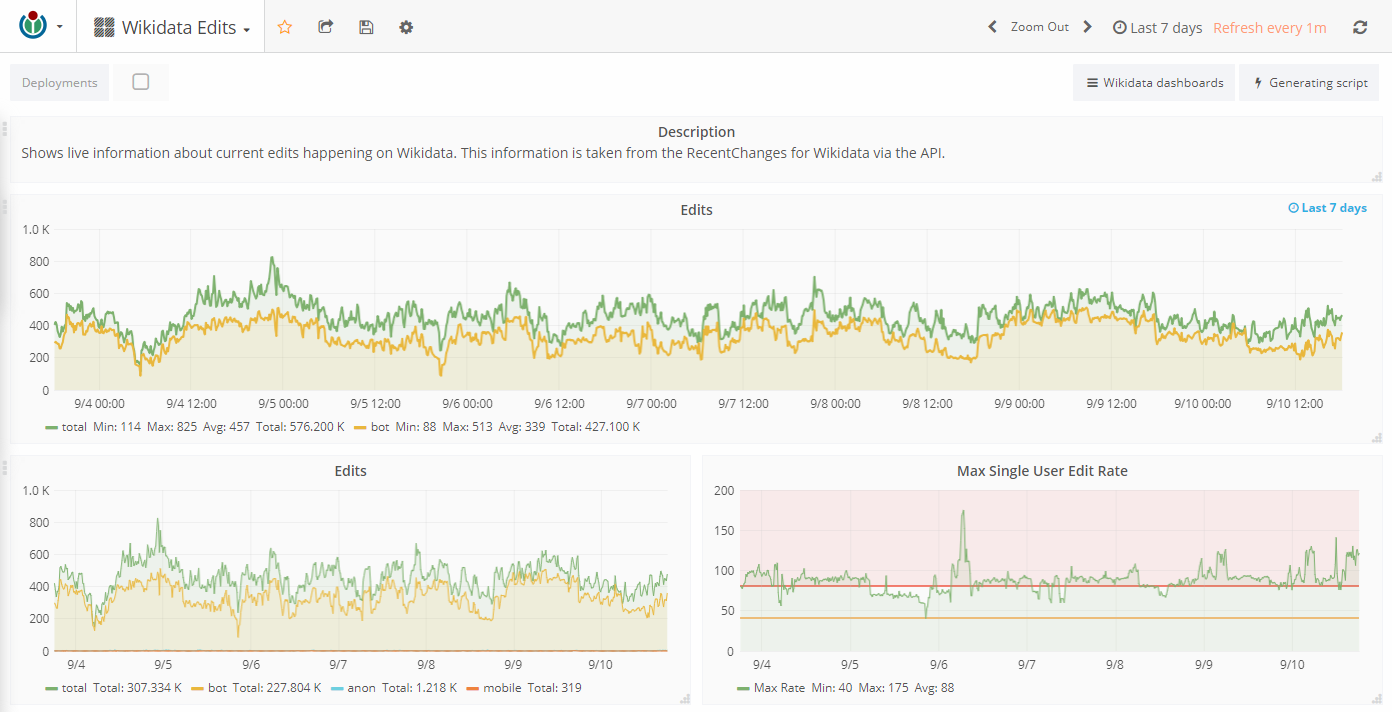
The dashboard in question is the Wikidata Edits dashboard hosted on the Wikimedia Grafana instance that is public for all to see. The top of the dashboard features a panel that shows the total number of edits on Wikidata in the past 7 days. The rest of the dashboard breaks these edits down further, including another general edits panel on the left of the second row. 

Read more

Using Hue & Hive to quickly determine Wikidata API maxlag usage

Hue, or Hadoop User Experience is described by its documentation pages as “a Web application that enables you to easily interact with an Hadoop cluster”.

The Wikimedia Foundation has a Hue frontend for their Hadoop cluster, which contains various datasets including web requests, API usage and the MediaWiki edit history for all hosted sites. The install can be accessed at https://hue.wikimedia.org/ using Wikimedia LDAP for authentication.

Once logged in Hue can be used to write Hive queries with syntax highlighting, auto suggestions and formatting, as well as allowing users to save queries with names and descriptions, run queries from the browser and watch hadoop job execution state.

The Wikidata & maxlag bit

MediaWiki has a maxlag API parameter that can be passed alongside API requests in order to cause errors / stop writes from happening when the DB servers are lagging behind the master. Within MediaWiki this lag can also be raised when the JobQueue is very full. Recently Wikibase introduced the ability to raise this lag when the Dispatching of changes to client projects is also lagged behind. In order to see how effective this will be, we can take a look at previous API calls.

Read more

The Wikimedia Server Admin Logs

The Wikimedia Server Admin Log or SAL for short is a timestamped log of actions performed on the Wikimedia cluster by users such as roots and deployers. The log is stored on the WikiTech Wikimedia project and can be found at the following URL: https://wikitech.wikimedia.org/wiki/Server_Admin_Log

An example entry in the log could be:

09:04 addshore: addshore@terbium:~$ for i in {1..2500}; do echo Lexeme:L$i; done | mwscript purgePage.php --wiki wikidatawiki

As well as the main cluster SAL there are also logs for release engineering (jenkins, zuul, and other CI things) and individual logs for each project that uses Wikimedia Cloud VPS.

A tool has been created for easy SAL navigation which can be found at https://tools.wmflabs.org/sal

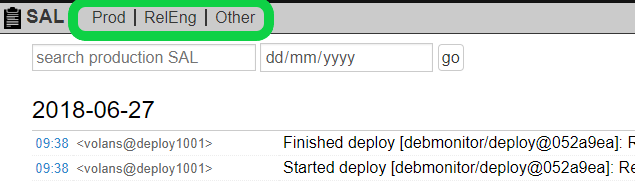
Each SAL can be selected at the top of the tool, with ‘Other’ providing you with a list of all Cloud VPS SALs.

The search and date filters can then be used to find entries throughout history.

Read more

WMDE: CI, Deploys & Config changes intro

This is an internal WMDE presentation made to introduce people to the land of Wikimedia CI, MediaWiki deployment and config changes. This briefly covers: Jenkins & Zuul CI Config Beta Cluster SWAT The MediaWiki train Monitoring mediawiki-config The Docker & Kubernetes future?

From 0 to Kubernetes cluster with Ingress on custom VMs

While working on a new Mediawiki project, and trying to setup a Kubernetes cluster on Wikimedia Cloud VPS to run it on, I hit a couple of snags. These were mainly to do with ingress into the cluster through a single static IP address and some sort of load balancer, which is usually provided by your cloud provider. I faffed around with various NodePort things, custom load balancer setups and ingress configurations before finally getting to a solution that worked for me using ingress and a traefik load balancer.

Below you’ll find my walk through, which works on Wikimedia Cloud VPS. Cloud VPS is an openstack powered public cloud solution. The walkthrough should also work for any other VPS host or a bare metal setup with few or no alterations.

Read more

Wikibase docker images

This is a belated post about the Wikibase docker images that I recently created for the Wikidata 5th birthday. You can find the various images on docker hub and matching Dockerfiles on github. These images combined allow you to quickly create docker containers for Wikibase backed by MySQL and with a SPARQL query service running alongside updating live from the Wikibase install.

A setup was demoed at the first Wikidatacon event in Berlin on the 29th of October 2017 and can be seen at roughly 41:10 in the demo of presents video which can be seen below.

Read more

Wikimedia Commons Android App Pre-Hackathon

The Wikimedia Commons Android App allows users to upload photos to Commons directly from their phone. The website for the app details some of the features and the code can be found on GitHub. A hackathon was organized in Prague to work on the app in the run up to the yearly Wikimedia Hackathon which … Read more

The RevisionSlider

The RevisionSlider is an extension for MediaWiki that has just been deployed on all Wikipedias and other Wikimedia websites as a beta feature. The extension was developed by Wikimedia Germany as part of their focus on technical wishes of the German speaking Wikimedia community. This post will look at the RevisionSliders design, development and use so far.

Read more

WMDE: Metrics & Data Gatherings

Below you will find an internal WMDE presentation covering the general area of WMDE Metric & Data Gatherings from 2016. This presentation follows on from the initial introduction to engineering analytics activities. The presentation skims through: WMDE Grafana dashboards The Wikimedia Analytics landscape Grafana & graphite Hadoop, Kafka, Hive & Oozie EventLogging, Mysql replicas & … Read more