Editing Grokipedia, a first look

As a long time editor and developer in the Wikipedia and Wikimedia space, I’m of course sceptical about what Grokipedia is trying to be, and if it stands any chance of success. it may struggle to deliver the resilience, transparency, and community processes that keep projects like Wikipedia thriving, and in the early weeks the untouchable AI generated content was certainly not going to work moving forward.

However, in the last week or so editing became an option, hidden behind Grok as a safeguard against abuse.

I thought I’d have a look at trying to edit a few of areas of content to see what the experience is like, and capture some of the good and bad points.

In no particular order…

Broken link formatting

A fix attempt

The Donald Trump articles has some broken formatting, which looks like an incorrectly parsed or formatted Markdown link that is now just showing in the HTML of the page. For posterity, I captured a copy of this version of the page on archive.ph, but here is a snapshot of how it appears.

Read more

COVID-19 Wikipedia pageview spikes, 2019-2022

Back in 2019 at the start of the COVID-19 outbreak, Wikipedia saw large spikes in page views on COVID-19 related topics while people here hunting for information.

I briefly looked at some of the spikes in March 2020 using the easy-to-use pageview tool for Wikimedia sites. But the problem with viewing the spikes through this tool is that you can only look at 10 pages at a time on a single site, when in reality you’d want to look at many pages relating to a topic, across multiple sites at once.

I wrote a notebook to do just this, submitted it for privacy review, and I am finally getting around to putting some of those moving parts and visualizations in public view.

Methodology

It certainly isn’t perfect, but the representation of spikes is much more accurate than looking at a single Wikipedia or set of hand selected pages.

  1. Find statements on Wikidata that relate to COVID-19 items
  2. Find Wikipedia site links for these items
  3. Find previous names of these pages if they have been moved
  4. Lookup pageviews for all titles in the pageview_hourly dataset
  5. Compile into a gigantic table and make some graphs using plotly

I’ll come onto the details later, but first for the…

Graphics

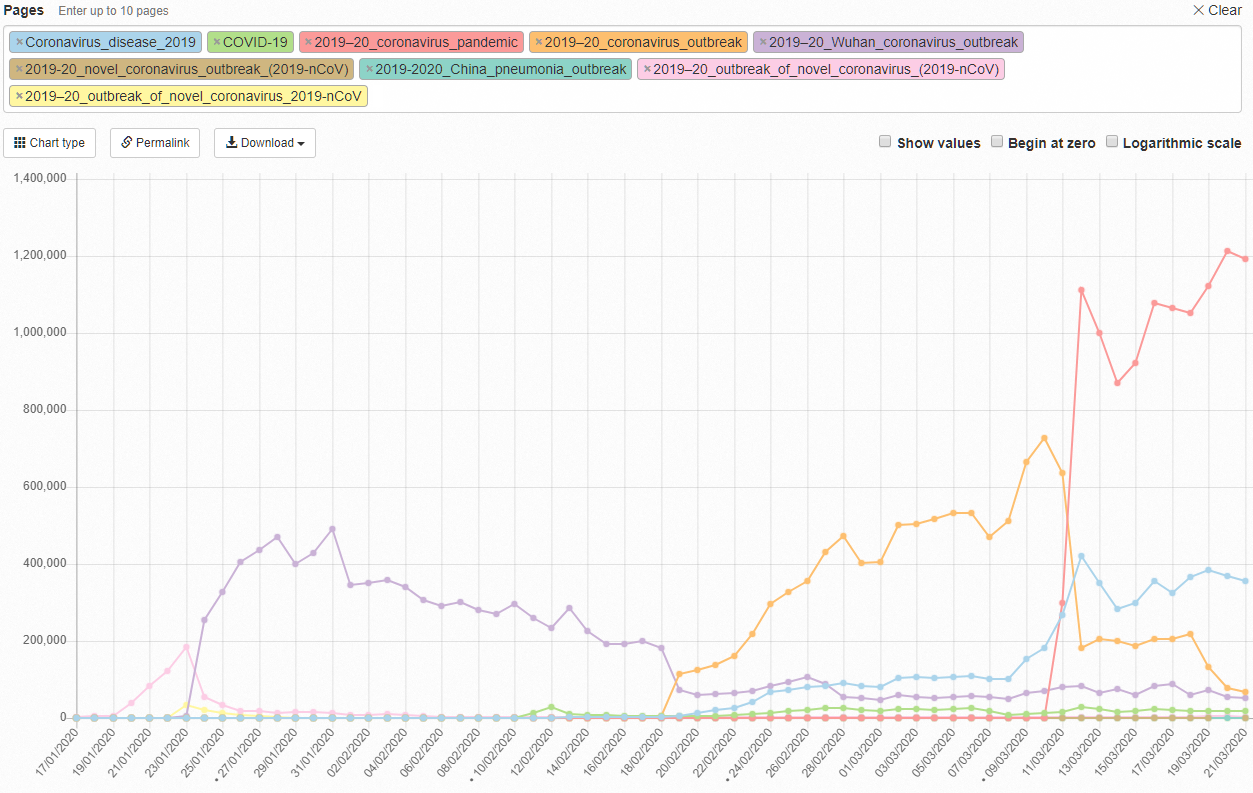
All graphics generally show an initial peak in the run-up to the WHO declaring an international public health emergency (12 Feb 2020), and another peak starting prior to the WHO declaring a pandemic.

Be sure to have a look at the interactive views of each diagram to really see the details.

COVID-19 related Wikimedia pageviews (interactive view)

Read more

Wikimedia Enterprise: A first look

Wikimedia Enterprise is a new (now 1-year-old) service and offered by the Wikimedia Foundation, via Wikimedia, LLC.

This is a wholly-owned LLC that provides opt-in services for third-party content reuse, delivered via API services.

In essence, this means that Wikimedia Enterprise is an optional product that third parties can choose to use that repackages data from within Wikimedia projects in a more useful, more reliable, and stable format presenting them primarily via data downloads and APIs, with profits going into the Wikimedia Foundation.

Want to find out more? Read the FAQ.

The project and APIs are well documented, and access can be requested for free, but I wanted to spend a little bit of time hands-on with the APIs to get a full understanding of what is offered, the formats, and how it differs from things I know are exposed elsewhere in Wikimedia projects.

Account Creation

Wikimedia Enterprise accounts are separate from any other Wikimedia related accounts, so you’ll need a new one.

In order to get an account you need to fill out a pretty straightforward form (username, password, email, and accept terms). You then need to verify your email address. Tada, you are in!

Read more

A first look at WikiCrowd

I have quite enjoyed the odd contribution to an app by Google called Crowdsource. You can find it either on the web, or also as an app.

Crowdsource allows people to throw data at Google in controlled ways to add to the massive pile of data that Google uses to improve its services and at the end of the day beat its competition.

It does this by providing a collection of micro contribution tasks in a marginally gamified way, similar to how Google Maps contributions get you Local Guide points etc. In Crowdsource you get a contribution count, a level, and a metric for agreements.

While I enjoy making the odd contribution when bored out of my mind and enjoy looking at the new challenges (currently at 2625 contributions), I always think that data like this should just be going out into the world under a free licence to benefit everyone.

So finally, introducing WikiCrowd, an interface, and soon to be app, that I developed over the new year period.

WikiCrowd Overview

WikiCrowd is hosted on toolforge and can be found at https://wikicrowd.toolforge.org/ (Source code on Github)

In order to contribute, you need some knowledge of the world, a Wikimedia account and that’s it!

Screenshot showing the wikicrowd application, listing various groups of questions users can contribute to

Read more

Reflection on filling a new Wikidata item

A few days ago I watched a Twitch stream by Molly / GorillaWarfare where they created the Louis W. Roberts English Wikipedia page. I decided to follow along and populate the matching Wikidata item (Q109662645) with as much information as I could from the same references that were being found for the Wikipedia article.

Along the way, I remembered some of the quirks of the manual editing experience for Wikidata and noted some other things that generally might be interesting folks.

This is a write-up of those thoughts.

Read more

Covid-19 Wikipedia pageviews, a first look

World events often have a dramatic impact on online services. A past example would be the death of Michael Jackson which brought down Twitter and Wikipedia and made Google believe that they were under attack according to the BBC.

Events like the COVID-19 (Coronavirus) pandemic have less instantaneous affect but trends can still be seen to change. Cloudflare recently posted about some of the internet wide traffic changes due to the pandemic and various government announcements, quarantines and lockdowns.

Currently the main English Wikipedia article for the COVID-19 pandemic is receiving roughly 1.2 million page views per day (14 per second). This article has already gone through 4 different names over the past months, and the pageview rate continues to climb.

Wikipedia pageviews tool showing English Wikipedia COVID-19 pandemic article views up to 21 March 2020 (source)

Read more

Hacking vs Editing, Wikipedia & Declan Donnelly

On the 18th of November 2018 the Wikipedia article for Declan Donnelly was edited and vandalised. Vandalism isn’t new on Wikipedia, it happens to all sorts of articles throughout every day. A few minutes after the vandalism the change made its way to Twitter and from there on to some media outlets such as thesun.co.uk and  metro.co.uk the following day, with another headline scaremongering and misleading using the word “hack”.

“I’m A Celebrity fans hack Declan Donnelly by changing his height on Wikipedia after Holly Willoughby mocks him”

Hacking has nothing to do with it. One of the definitions of hacking is to “gain unauthorized access to data in a system or computer”. What actually happened is someone, somewhere, edited the article, which everyone is able and authorized  to do. Editing is a feature, and its the main action that happens on Wikipedia.

The word ‘hack’ used to mean something, and hackers were known for their technical brilliance and creativity. Now, literally anything is a hack — anything — to the point where the term is meaningless, and should be retired.


The word ‘hack’ is meaningless and should be retired – 15 June 2018 by MATTHEW HUGHES

Read more

Spike in Adam Conover Wikipedia page views | WikiWhat Epsiode 4

This post relates to the WikiWhat Youtube video entitled “Adam Conover Does Not Like Fact Checking | WikiWhat Epsiode 4” by channel Cntrl+Alt+Delete. It would appear that the video went slightly viral over the past few days, so let’s take a quick look at the impact that had on the Wikipedia page view for Adam’s article.

Read more

Google Assistant & Wikipedia

googleassistant-wikipedia1The Google Assistant is essentially a chat bot that you can talk too within the new Allo chat app. The assistant is also baked into some new Google hardware, such as the pixel phones. During a quick test of the assistant, I noticed that if you ask it to “tell me an interesting fact” sometimes it will respond with facts from Wikipedia.

Read more

The RevisionSlider

The RevisionSlider is an extension for MediaWiki that has just been deployed on all Wikipedias and other Wikimedia websites as a beta feature. The extension was developed by Wikimedia Germany as part of their focus on technical wishes of the German speaking Wikimedia community. This post will look at the RevisionSliders design, development and use so far.

Read more