Late to “AI” assisted development?

Earlier this week, someone asked me if they were perhaps late to making use of AI-assisted development, as they dove into it in the past 2 months (using GitHub Copilot) and are already seeing large gains in a small team in terms of leverage of time. I thought for a second and responded that they might have seen comparably worthwhile gains roughly a year ago. In this post, I’m going to take a look back over the past years to try and figure out what the timeline has actually looked like.

My own vauge memory isn’t very certain, and roughly speaking pre COVID I dont remember much AI being used in software development, and after COVID we were in the AI era? The first place I personally remember using assisted development was via the initial VSCode GitHub Copilot auto completions, which were at the time questionably useful to start with but still showed promise. Included along the way will likely be the first version of Claude Code, Gemini entering the scene, and within GitHub copilot the advancements from completions, to ask & edit, to agent, and finally autopilot and cloud agents.

2017 – 2022: The Transformer era

And although there are other notable mentions, such as BERT by Google in 2018 and CodeBERT in 2020, most of the above comes far before most people will have started looking at or using AI for coding, and that includes me. As I initially started using models during development with the introduction of GitHub Copilot and the autocompletions within VSCode.

GitHub Copilot Technical Preview (June 2021+)

My email innivation to the GitHub Copilot Technical Preview came back in on the 8th July 2021, and it looks like the public announcement on the GitHub blog can still be found dated 29th June 2021.
Read more

Easily monitor your GitHub API limits and throttling

For one reason or another I have run into GitHub core API limits or been throttled in the last few weeks, which has generally annoyed me, and leads to some workflows (such as using GitHub Copilot in an IDE) to be broken, even though such things seemingly have their own API limits and restrictions, they often rely on core to do some things…

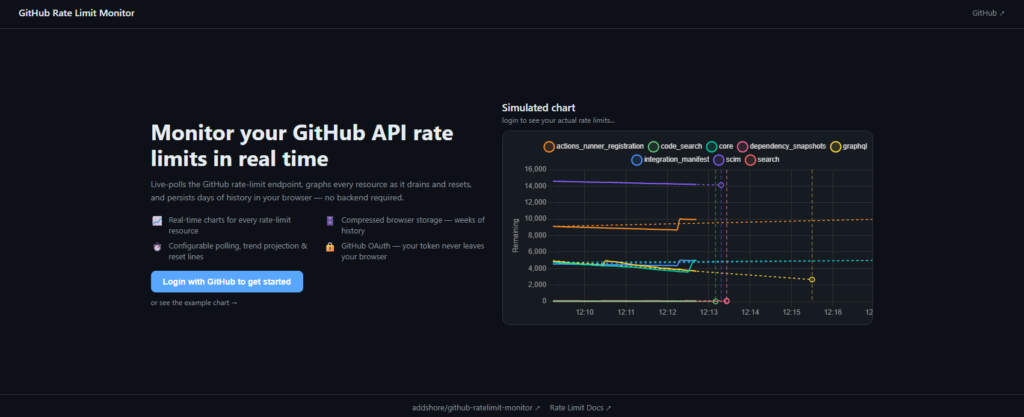
As a result I wrote a little script to poll the GitHub API and graph it to try and spot the moments that the limits were all consumed (I’m pretty sure it was down to be including some large file in a context, or doing something else undesirable), and this was fairly OK. I ended up turning this into something that would live graph the usage in the terminal for me so that I didn’t have to read numbers, and before you know if, I guided an agent through making a full UI and created my first authenticated GitHub app.

So now if you end up in a similar situation to me and just want to track your GitHub usage limits for the next hour, you can head to https://github-ratelimit-monitor.addshore.com/, login and see a pretty graph, visualize the data in a few different ways, predict when your going to hit the limits, see when your limits will reset, and download the raw data after.

Naturally, since making it, I haven’t reached a limit, but I’m going to leave it running in the background for the next few days anyway for fun…

You can find the code on GitHub https://github.com/addshore/github-ratelimit-monitor and some pictures below.

Or just go and try it out! https://github-ratelimit-monitor.addshore.com/

Read more

Fixing Wikimedia Commons thumbnail sized (on my blog)

As AI crawling and training continues to stress the web, the Wikimedia foundation continues to change various things in their edge rules and internal processes. Recently the Wikimedia Hackathon Northwestern Europe 2026 was likely one of the largest technical events organized after some of the new rate limits came into play, and it wasn’t without issue at the event (though we got by).

Image thumbnails are a bit of a different story, and the backend service has been restricted to the number of thumbnail sizes that can be generated, stored and served, with some new defaults put in place.

Current standard sizes in Wikimedia production: 20px, 40px, 60px, 120px, 250px, 330px, 500px, 960px, 1280px, 1920px, 3840px

Common thumbnail sizes

If you want to read some of the research and decisions that went into it, take a look at T211661#8377883 and other linked tickets.

Anyway, these changes lead to some posts on my blog, which used now non supported thumbnail sizes to fail to load said thumbnails.

Instead of getting the image (or any image at all), the requests is instead served with an error page from the edge, with a link for further information, which also happens to be a 429 response. Though it appears there are no headers around retrying the request.

Error

Use thumbnail steps listed on https://w.wiki/GHai. Please contact noc@wikimedia.org for further information (a765913)

Read more