What was Wikibase “Federated Properties”

The “Federated Properties” feature allows / allowed a local Wikibase instance to access and utilise properties directly from a remote Wikibase, primarily Wikidata. Its primary purpose is to enable partial federation between a local Wikibase and Wikidata, broadening the base of available data without needing to create a property set from scratch.

I’m split between using the present and past tense here, as all of this code still exists within the Wikibase extension, however no one has used it since 2022, and it certainly doesn’t seem to be on the short or medium term (or maybe even long term) roadmaps.

This overview comes from the Wikibase – Federated Properties Phabricator project, which I’ll quote the whole of here for prosperity.

Federated Properties v2 (2021)
An initiative to give users the ability to access remote properties from their local Wikibase and use them in combination with custom local properties. The primary use case is enabling partial federation between a Wikibase and Wikidata. This version of the feature will allow you to:

  • Opt-in to use Wikidata’s properties in addition to your own custom local properties
  • Create and view statements about local entities that contain both local and federated properties
  • Query your Wikibase using both local and federated properties

Federated Properties v1 (2020-2021)
An initiative to give users the ability to access remote properties from their local Wikibase (no local properties were possible in this MVP). This version was launched in the Wikibase Spring Release in May 2021.

As far as I remember, the project died with v2, and I don’t even recall if v2 really saw the light of day outside WMDE internal testing and or hidden testing on wikibase.cloud.

Read more

2 years of wikibase.cloud by WMDE

It’s been somewhere between 2 and 3 years since WMDE took over WBStack, turned it into wikibase.cloud. During this time, my techy focus has slowly shifted away from the world of Wikibase, though I still enjoy following along and working on other Wikimedia areas.

Here I will ramble on about what I saw in terms of potential for wikibase.cloud within the Wikibase ecosystem, as well as what developments have happened within the past years.

The initial problems, goals and dreams

From An introduction to WBStack, I said:

The idea behind the project is to provide Wikibase and surrounding services, such as a blazegraph query service, query service ui, quick statements, and others on a shared platform where installs, upgrades and maintenance are handled centrally.

Now, this is fairly obvious, and clearly something that wikibase.cloud still offers today, however I didn’t write why!? And this is potentially something that has gotten lost through the years of multiple PMs, multiple engineers, multiple project names etc.

Read more

2022 Year Review

This entry is part 6 of 6 in the series Year Reviews

I’ve been doing year reviews since 2017 under the #year-review tag, and 2022 is no different. Expect I have been living aboard a sailboat traveling the world for the latter half of the year. So this year is probably going to look a little different in retrospect, including far less time coding and writing about technology, but far more nautical miles traveled.

(the GPS track below is mostly accurate, but also has some odd artifact in it…)

Blogging (and Boating)

The trip has resulted in some alternative blogging about sailboats, and much of which has been on an entirely separate blog https://sailinghannahpenn.co.uk.

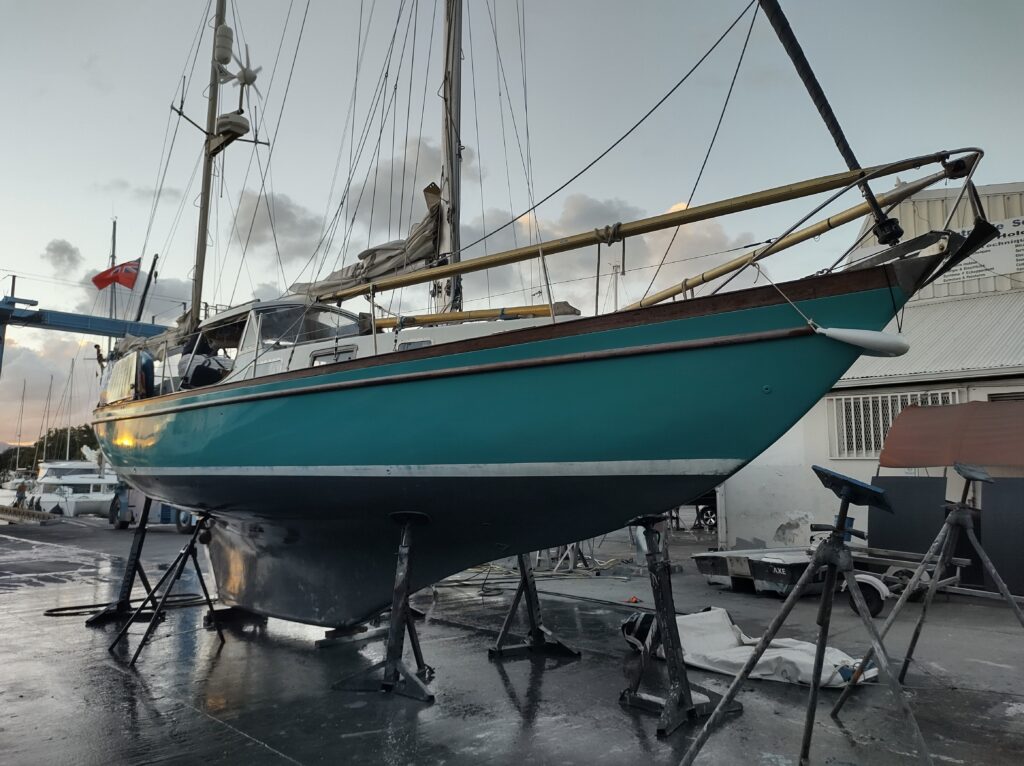
In fact, here is a picture of Hannah Penn from last week after hauling out of the water in Guadeloupe for form extra painting.

There is always lots to be doing while sailing, and second to sailing comes enjoyment. I have also been working 10h per week for Wikimedia Deutschland, and altogether this leaves sparse gaps for other things on the side like blogs.

Read more

Infrastructure as Code for wbstack deployments

This entry is part 12 of 12 in the series WBStack

For most of its life wbstack was a mostly one-man operation. This certainly sped up the decision making process around features, requests, communication and prioritization, I also had to maintain a complex and young project supporting hundreds of sites on the side of my regular 8 hour day job.

In order to ensure that I’d feel comfortable with this extra context, be able to support the platform for multiple years, have a platform that could grow and scale from day one and also leave the future of the platform with as many possibilities as possible I roughly followed a few principles throughout implementation and operation.

  • Scalability: Tink about scale at multiple levels. Everything was either already horizontally scalable, or the path to get to horizontal scalability had been thought out
  • Automation: Automate actions, if you have 2 of something now, pretend you have 1000 of them instead and develop the solution to fit
  • Infrastructure as code: All infrastructure configuration was contained somehow in the deploy repository
  • Cloud agnostic: Things would be cloud-agnostic where possible, resulting in most things being in Kubernetes or using other external services
  • Own fewer things: Try to not create many new services or codebases, or take ownership of forks that should not exist, as this will become too much work

The one part of the above list that I want to dive into more in this post is infrastructure as code and how it worked for the multi-year lifespan of wbstack, before the move to wikibase.cloud.

Read more

Wikibase a history

I have had the pleasure of being part of the Wikibase journey one way or another since 2013 when I first joined Wikimedia Germany to work on Wikidata. That long-running relation to the project should put me in a fairly good position to give a high-level overview of the history, from both a technical and higher-level perspective. So here it goes.

For those that don’t know Wikibase is code that powers wikidata.org, and a growing number of other sites. If you want to know more read about it on Wikipedia, or the Wikibase website.

For this reason, a lot of the early timeline is quite heavy on the Wikidata side. There are certainly some key points missing, if you think they are worthy of mentioning then leave a comment or reach out!

Read more

WBStack close and migration

This entry is part 11 of 12 in the series WBStack

The time is approaching for the end of life of the WBStack alpha platform (don’t worry, it’s still some months away, and there is a migration path to a new platform etc :)).

In this post you’ll find an update on the current state of WBStack, another introduction to Wikibase.Cloud, some rough dates and connections to other communications. If you don’t know what WBStack is then you can start with this introduction.

Wikibase.Cloud

Following the pre launch announcement of Wikibase.Cloud at WikidataCon 2021, the WMDE team has been working on getting the new platform set up and ready to replace wbstack.com. This includes updates to components such as MediaWiki, Wikibase, reworking components, modifying code bases to be more easily maintained by a team, and generally getting to grips with the platform.

This new platform uses the same codebases, and architecture as wbstack.com does currently, but it is maintained by a team at Wikimedia Deutschland, rather than me, an individual.

You can read more on the launch from the WMDE perspective in the mailing list post that will be sent at the same time as this blog post.

Initially, Wikibase.cloud will launch as a closed beta for WBStack users who registered before February 2nd, 2022 with a waiting list for later expansion. To join the waiting list, please fill out this form https://lime.wikimedia.de/index.php/717538. Please note that the waitlist will be considered after WBStack migration has completed.

For current users of WBStack, you do not need to join this waitlist. You will receive an email with details on how you can opt-in to a migration to wikibase.cloud in March.

wikibase-cloud mailing list February 2022

As migration time approaches, I will be reaching out to the current users of WBStack about the options and approach to migration. And if you are a current user, it’s worth reading the rest of this post.

Read more

Pre-launch Announcement of Wikibase.Cloud [WikidataCon Writeup]

This entry is part 10 of 12 in the series WBStack

WikidataCon 2021 was in October 2021, and one of the sessions that I spoke in was a “Pre-launch Announcement and Preview of Wikibase.Cloud”.

The recording is now up on YouTube, and below you’ll find a write-up summary of what was said.

You can also find:

So what is wikibase.cloud?

It’s a new platform that has yet to be launched, that is based on WBStack code, but that will be managed and maintained by Wikimedia Deutschland (or Wikimedia Germany).

This is a Wikibase as a service platform, that exists to offer open knowledge projects a new way to create their own Wikibase very quickly and very easily.

Read more

WBStack in 2021 and the future

This entry is part 9 of 12 in the series WBStack

2021 is nearly over, WBStack is over 2 years old (initially announced back in 2019), and has continued to grow. The future is bright with wikibase.cloud looking to be launched by Wikimedia Deutschland in the new year (announced at WikidataCon 2021), and as a result, the code under the surface has had the most eyes on it since its inception.

Let’s take a closer look at some of the developments this year, and the progress that WBStack has made.

Current Usage

WBStack now has 148 individual user accounts registered on the platform that enabled wiki creation. These accounts have created 510 wikis with Wikibase installed since the platform was initially put online, and 335 of those wikis are still currently published (the other 175 have been deleted).

Nov 2019April 2020May 2020Nov 2021Dec 2021
Platform Users387076139148
Non deleted Wikis145306335
All Wikis65178226476510
Pages1.4 million1.9 million
Edits200,000295,0004.1 million4.6 million

Read more

Delete all Github releases, using the Github cli

If you are like me, at some point while developing projects on Github you will have started and stopped using releases, opting to switch back to only creating tags. Github defaults leave you in a bit of an awkward position here where the “Releases” section in the side bar will continue to show your old … Read more

WBStack setting changes, Federated properties, Wikidata entity mapping & more

During the first 3 months of 2021, some Wikimedia Deutschland engineers, from the Wikidata / Wikibase team, spent some time working on WBStack as part of an effort to explore the WBaaS (Wikibase as a service) topic during the year, as outlined by the development plan.

We want to make it easier for non-Wikimedia projects to set up Wikibase for the first time and to evaluate the viability of Wikibase as a Service.

Wikibase 2021 Development plan

This has lead to a few new Wikibase features being exposed through the WBStack dashboard for sites that run on the platform. These features are primarily features developed by the Wikibase team in 2020 and 2021. The work also brought some other quality of life improvements for the settings pages.

Here is a quick rundown of what’s new and improved.

Read more