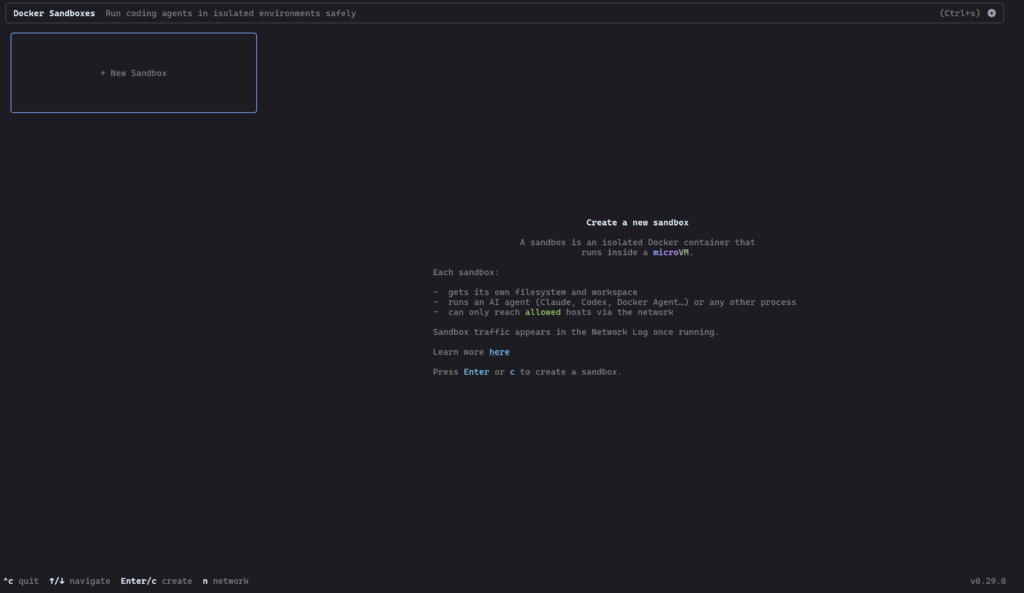
With local AI agents increasingly writing and executing code autonomously, giving them unrestricted access to your machine is becoming a massive security risk. This is one of the primary reasons that agentic flows have so many flavors of approval that may need to happen throughout an agents course of action, though others include review points and being able to keep the agent on track.
I have been very much enjoying my increased use of GitHub Cloud Agents in my work and play, which is rather powerful if you can setup your entire stack (more or less accurately) in a remote environment using VMs and containers. On the project that I currently work the most I have a copilot-setup-steps.yaml file or 53 lines leveraging my existing docker compose based development environment setup of 41 services that only takes 2 minutes to “install” (multi repo clones, and dependency installation), then allowing agent to run various different development configurations depending on the tasks at hand, using a mixture of the services (or not).
However today is the first day I’ll be taking a very brief look at Docker AI Sandboxes, to try and do more of this locally and or on machines nearby…
Historically I’m terrible at post Hackathon write ups, though a few do exist… (#hackathon posts). For the past few days I have been attending the Wikimedia Hackathon Northwestern Europe 2026 in Arnhem NL with around 70 other people. Around 42 projects were shown at the showcase, and I want to briefly look at some of those, and also document some of the other things that were going on in my vicinity.
On the whole, this was a great hcakathon, larger than the last NL organized hackathon, a beautifull venue, good organization, good food, good people, lots of conversation, and for me at least, everything was very convenient.
I came to the number 33, based on the fact that there were this many sites online on wikibase.world that have an exact match to the MediaWiki versions that have been released as part of the Wikibase Suite container images. And in all cases, this would be an overestimate, given that these versions would also be installed by some not using the images, so the likely number would be closer to ~16…
And of the 33 sites that might possibly be using “suite” as they are on the same version at least, probably 50% are installed via other means, so the “suite” installations probably account for ~16 of the wikibases in wikibase.world at a guesstimate, with ~50 using other methods and 711 using wikibase.cloud.
9th December 2025 Edit
Apparently this post attracted some attention, and I want to make it clear that “Wikibase suite” here is specifically talking about the packaging up of the container images / docker images into some single installable reusable magic component, and support system around it.
I personally believe the container images themselves are a great asset, and the idea of a suite of recommended extensions and applications that should be delivered alongside a Wikibase is also an asset that the ecosystem does need.
10 months on from this first look, while visiting the Wikimedia Germany offices, I found the need once again to try to come up with concrete numbers in terms of the users of Wikibase Suite, where my general motive would be to convince WMDE that resources are better spent in other places, such as supporting the underlying software, not just this fancy wrapper on top.
And with this new analysis, my revised number is roughly 18, of which 9 are possibly active, and 2 are likely lost to bot spam. You can find the list via this rather lengthy wikibase.world query.
I recently wrote a post looking at the history of the Wikibase “Federated Properties” feature. While at Wikimania 2025 the topic of federation came up a few times, particularly given the current discussions ongoing on the Wikidata project chat page including discussions about wikicite, and the recent Wikidata graph split.
All the code for the “Federated Properties” feature still exists in Wikibase code, despite a ticket being open on phabricator to potentially delete it. And it turns out that the configuration for it still exists on wikibase.cloud too, where the feature was initially presented to the communities to try out.
So with a little bit of sneaky “hacking”, I can try to summarize the current / final state of the “Federated Properties” feature, after development during the MVP stopped some years ago.
This also means you can still try out the feature on your own wiki using the setting.
The “Federated Properties” feature allows / allowed a local Wikibase instance to access and utilise properties directly from a remote Wikibase, primarily Wikidata. Its primary purpose is to enable partial federation between a local Wikibase and Wikidata, broadening the base of available data without needing to create a property set from scratch.
I’m split between using the present and past tense here, as all of this code still exists within the Wikibase extension, however no one has used it since 2022, and it certainly doesn’t seem to be on the short or medium term (or maybe even long term) roadmaps.
This overview comes from the Wikibase – Federated Properties Phabricator project, which I’ll quote the whole of here for prosperity.
Federated Properties v2 (2021) An initiative to give users the ability to access remote properties from their local Wikibase and use them in combination with custom local properties. The primary use case is enabling partial federation between a Wikibase and Wikidata. This version of the feature will allow you to:
Opt-in to use Wikidata’s properties in addition to your own custom local properties
Create and view statements about local entities that contain both local and federated properties
Query your Wikibase using both local and federated properties
Federated Properties v1 (2020-2021) An initiative to give users the ability to access remote properties from their local Wikibase (no local properties were possible in this MVP). This version was launched in the Wikibase Spring Release in May 2021.
As far as I remember, the project died with v2, and I don’t even recall if v2 really saw the light of day outside WMDE internal testing and or hidden testing on wikibase.cloud.
Wikimedia Commons now uses Structured Data on Commons (SDC) to make media information multilingual and machine-readable. A core part of SDC is the ‘depicts’ statement (P180), which identifies items clearly visible in a file. Depicts statements are crucial for MediaSearch, enabling it to find relevant results in any language by using Wikidata labels, as well as having pre precise definition and structure than the existing category structures.
SDC functionalities began to roll out in 2019. Multilingual file captions were introduced early that year, enabling broader accessibility, followed by the ability to add depicts statements directly on file pages and through the UploadWizard.
Although there are numbers floating around showing a general increase in usage of structured data on Commons, there didn’t seem to be any concrete numbers around the growth in use of depicts statements.
I was particularly interested in this, as must tool WikiCrowd is steadily becoming a more and more efficient way of adding these statements en masse. So I decided to see what data I could come up with.
I wrote a post in February 2025 looking at what the Wikibase ecosystem (might) look like, according to the data that had at that point been collected on wikibase.world. Now that data has had some time to evolve and expand, we can take a little look at how it has changed throughout the last 2 months.
In the future, I’ll try to remember to write something up every quarter or so (for now), until someone else feels like taking this over ;)
The latest notebooks for generating this are in git, and the latest XML file dumped from wikibase.world is on archive.org.
Site count and status
We have gone from tracking 777 sites, up to 873, so an increase of nearly 100 in 2 months.
However, we need to look at the tracked status to determine how big the current ecosystem actually might be. So I added a little extra counting to the notebook previously used to count the wikis based on P13 (availability status).
Back in Feb, there were 774 online, and only 3 marked as offline. This was primarily as Addbot was not often marking sites as offline, however I added automatic detection of deleted sites for wikibase.cloud and went through and checked a bunch of sites that the scripts were failing to lookup.
Looking at the April data, we have ~847 online, and ~26 offline, so an increase of around 3%.
Graph
Most of the growth in sites seems to come from wikibase.cloud, however many sites on wikibase.cloud are test sites and may not have much content.
So when displaying the graph this time, I’ll filter out everything that doesn’t have a highest Item ID of at least 25, this roughly cuts the size of the graph in half.
There has been some recent chat once again on the Wikibase telegram groups around importing, and the best approach to import a large amount of data into a Wikibase instance. 2 years ago I started a little GitHub project aimed at profiling the speed of loading using the action API, and various settings, DB versions etc, as well as trying out a bulk load API. And I have just taken the opportunity to take another look at it and try to visualize some of the comparisons given changes through the last 2 years.
In case you don’t want to read and follow everything below, the key takeaways are:
EPS (edits per second) of around 150 are achievable on a single laptop
When testing imports, you really need to test at least 50k items to get some good figures
The 2 ID generation related settings are VERY IMPORTANT if you want to maximise import times
Make async requests, but not too many, likely tuned to the number of CPUs you have serving web requests. You wan near 100% utilization
In October last year, I wrote a post starting to visualize the connections between Wikibases in the ecosystem that had been found and collected on wikibase.world thanks to my bot that I occasionally run. That post made use of the query service visualizations, and in this post I’ll take the visualizations a step further, making use of IPython notebooks and plotly.
Previously I reported the total number of Wikibases tracked in wikibase.world being around 784, with around 755 being active (however I didn’t write down exactly how I determined this). So I’m going to take another stab at that with some code backing up the determinations, rather than just my late night data ramblings.
All of the data shown in this post is generated from the IPython notebook available on Github, on 16 Feb 2025, based on the data on wikibase.world which is maintained as a best effort system.
General numbers
Metric
Value
Wikibases with properties
777
Wikibases with properties, and more than 10 pages
600
Wikibases with properties, and more than 10 pages, and 1 or more active users
264
Wikibases with properties, and more than 10 pages, and 2 or more active users
129
Wikibases that link to other wikibases
194
Wikibases that only link to non Wikimedia Foundation wikibases
5
Wikibases that link to other wikibases, excluding Wikimedia Foundation
35
A few things of note:
“with properties” is used, as a clear indicator that Wikibase is not only installed, but also used in at least a very basic way. (ie, it has a created Wikibase property). I would use the number of items ideally as a measure here, however as far as I can tell, this is hard to figure out?)
“with more than 10 pages” is my baseline measure of the site having some content, however this applies across all namespaces, so can also be wikitext pages…
“active users” are taken from MediaWiki statistics, and apply across all namespaces. These numbers also rely on MediaWiki being correctly maintained and these numbers actually being updated. (Users who have performed an action in the last 30 days)
“link to other wikibases” are links extracted from sites by Addbot either via external links or specific properties that state they are links to other wikibases. (The code is not pretty, but gives us an initial view)
And summarized in words:
264 Wikibases with some content that have been edited in the past 30 days
194 Wikibases link in some way to other Wikibases
Excluding links to Wikidata and Commons, this number comes down to 35 (So Wikidata is very much the centre)
And of course, take all of this with a pinch of salt, these numbers are an initial stab at trying to have an overview of the ecosystem.
An updated web
My October post included some basic visualizations from the query service of wikibase.world.
However, it’s time to get a little more fancy and interactive. (As well as showing all wikibases, not just the linked ones)
Over the past week I have spent some time writing some code to start running a little bot on the wikibase.world project, aimed at expanding the number of Wikibases that are collected there, and automating collection of some of the data that can easily be automated.
Over the past week, the bot has imported 650 Wikibase installs that increases the total to 784, and active to 755.
I mainly wanted to do this to try and visualize “federation” or rather, links between Wikibases that are currently occurring, hence creating P55 (links to Wikibase) and P56 (linked from Wikibase).