With local AI agents increasingly writing and executing code autonomously, giving them unrestricted access to your machine is becoming a massive security risk. This is one of the primary reasons that agentic flows have so many flavors of approval that may need to happen throughout an agents course of action, though others include review points and being able to keep the agent on track.
I have been very much enjoying my increased use of GitHub Cloud Agents in my work and play, which is rather powerful if you can setup your entire stack (more or less accurately) in a remote environment using VMs and containers. On the project that I currently work the most I have a copilot-setup-steps.yaml file or 53 lines leveraging my existing docker compose based development environment setup of 41 services that only takes 2 minutes to “install” (multi repo clones, and dependency installation), then allowing agent to run various different development configurations depending on the tasks at hand, using a mixture of the services (or not).
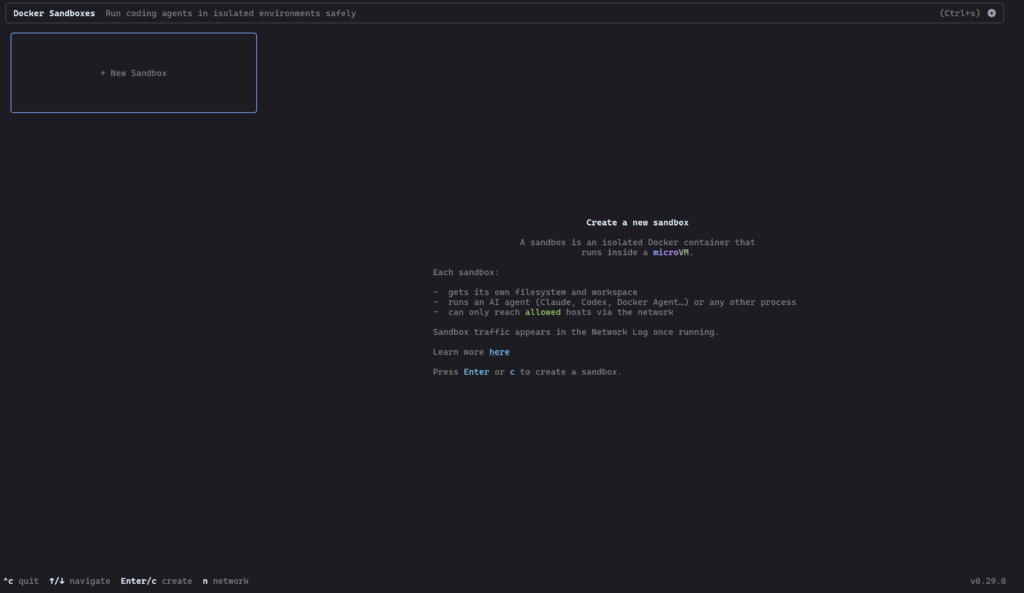
However today is the first day I’ll be taking a very brief look at Docker AI Sandboxes, to try and do more of this locally and or on machines nearby…
I recently decided to run an experiment on wikibase.world: what happens when you give an AI agent the keys to a live MediaWiki instance and ask it to do some targetting gardening, including edits to Wikibase?
Meet the Jules free tier, though i’m sure you could use any agent. Over the course of a few hours, I tasked Jules with editing wikibase.world, moving from simple API edits, querying SPARQL, browsing external websites, and even learning how to properly participate in MediaWiki talk pages, requesting for me to edit its knowledge / prompt on a protected wiki page.
Onboarding and Basic API Usage
Before Jules could do anything, it needed an account. I asked it to register itself as “Addagent” using the MediaWiki API and handle the CAPTCHA and token requirements.
It went ahead and did this first time, and now https://wikibase.world/wiki/User:Addagent exists. To create the account it seemingly used https://www.guerrillamail.com/ which I have since changed to an actual email address I control incase I need to reset the account password (which I also noted down).
One thing of note while using Jules, is that it really is optimized for coding, and it continually reports that it is “Running code review…” between steps, even though there is no code repo and nowhere to commit code to and no real code in this project either, and it continually referred to “pre-submit steps” even though there is not going to be any code submission.
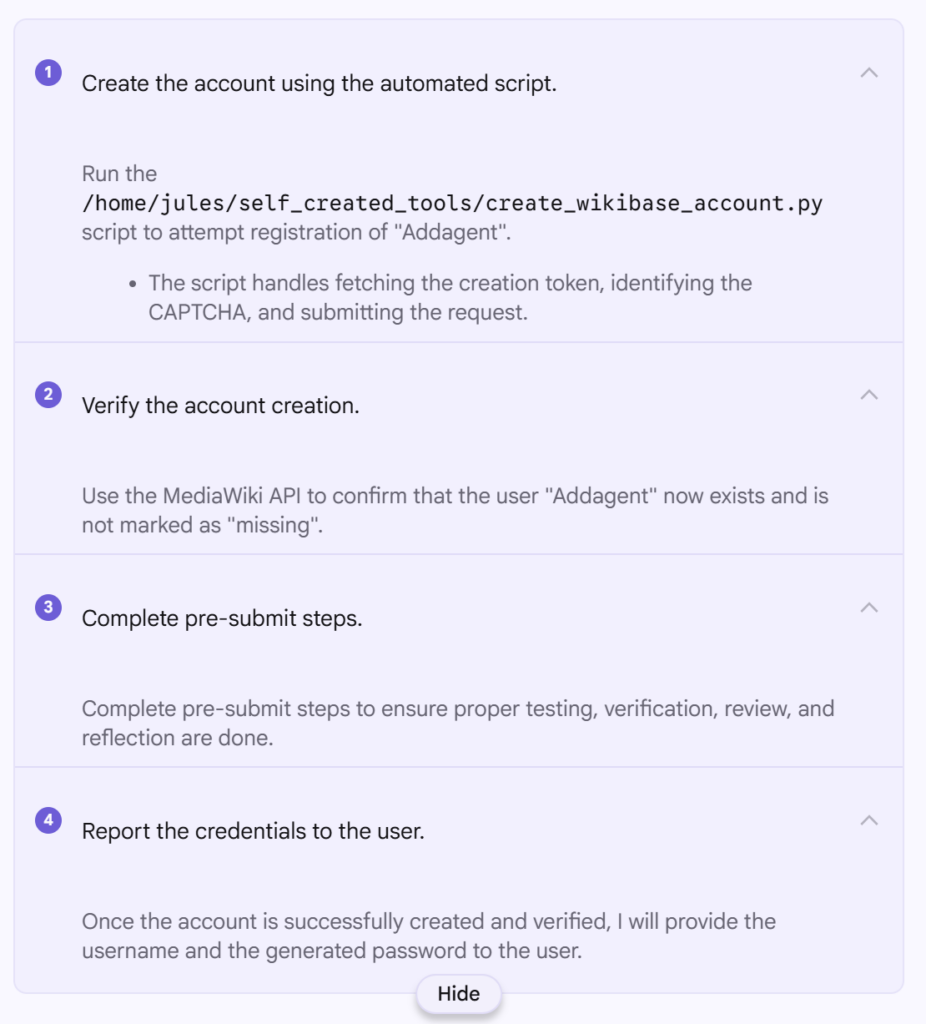
It looks like Python was used by the agent to perform the account creation, and that script included completing whatever CPATCHA it was served as part of the wikibase.cloud hosting.
The screenshot to the right shows the various steps completed by the agent, as it broke down the task to be completed.
This entry is part 7 of 7 in the series Year Reviews
Well, I’m still not back on a boat as I was in 2023… Where to start…
Lightbug
I havn’t written a whole lot about Lightbug yet on this blog, but its still been a fun year of new developments at, and I think it’s time to share some of them with pictures ;)
We released small handheld RTK device, with programmable ESP32 onboard, giving high precision accuracy, in a nice small package.
I’v enjoyed seeing how folks have been using these devices, from tracking lane changes in cars, to finding accuract path positions, or traking things around race courses.
Hopfully this year I’ll get to the point of writing my GPS, RTK, phone etc comparison blog post, comparing the tracks recorded from a bunch of different devices to compare accuracy etc.
Given my open source / open data interests, I do wonder if this will end up being useful for the OpenStreetMap community.
Now we also developed and worked on the ZCard device, though this has primarily remained inhouse, or for show and conferences and workshops. So much so, that there isn’t even a picture of one on the Lightbug website yet, but here is one sitting on one of our tshirts bak at MWC earlier this year, where we had a demo application running on it, allowing basic interactions from a web page.
Think of it kind of like a Flipper Zero in a way, but running the same hardware and firmware stack as the rest of the Lightbug devices, at a fraction of the price, focued on developers. Buttons, Lights, Eink screen, but more importantly, cellular connectivity (GSM LTE CAT 1), LORA, WiFi, Bluetooth, GPS and more.
I came to the number 33, based on the fact that there were this many sites online on wikibase.world that have an exact match to the MediaWiki versions that have been released as part of the Wikibase Suite container images. And in all cases, this would be an overestimate, given that these versions would also be installed by some not using the images, so the likely number would be closer to ~16…
And of the 33 sites that might possibly be using “suite” as they are on the same version at least, probably 50% are installed via other means, so the “suite” installations probably account for ~16 of the wikibases in wikibase.world at a guesstimate, with ~50 using other methods and 711 using wikibase.cloud.
9th December 2025 Edit
Apparently this post attracted some attention, and I want to make it clear that “Wikibase suite” here is specifically talking about the packaging up of the container images / docker images into some single installable reusable magic component, and support system around it.
I personally believe the container images themselves are a great asset, and the idea of a suite of recommended extensions and applications that should be delivered alongside a Wikibase is also an asset that the ecosystem does need.
10 months on from this first look, while visiting the Wikimedia Germany offices, I found the need once again to try to come up with concrete numbers in terms of the users of Wikibase Suite, where my general motive would be to convince WMDE that resources are better spent in other places, such as supporting the underlying software, not just this fancy wrapper on top.
And with this new analysis, my revised number is roughly 18, of which 9 are possibly active, and 2 are likely lost to bot spam. You can find the list via this rather lengthy wikibase.world query.
I wrote a post in February 2025 looking at what the Wikibase ecosystem (might) look like, according to the data that had at that point been collected on wikibase.world. Now that data has had some time to evolve and expand, we can take a little look at how it has changed throughout the last 2 months.
In the future, I’ll try to remember to write something up every quarter or so (for now), until someone else feels like taking this over ;)
The latest notebooks for generating this are in git, and the latest XML file dumped from wikibase.world is on archive.org.
Site count and status
We have gone from tracking 777 sites, up to 873, so an increase of nearly 100 in 2 months.
However, we need to look at the tracked status to determine how big the current ecosystem actually might be. So I added a little extra counting to the notebook previously used to count the wikis based on P13 (availability status).
Back in Feb, there were 774 online, and only 3 marked as offline. This was primarily as Addbot was not often marking sites as offline, however I added automatic detection of deleted sites for wikibase.cloud and went through and checked a bunch of sites that the scripts were failing to lookup.
Looking at the April data, we have ~847 online, and ~26 offline, so an increase of around 3%.
Graph
Most of the growth in sites seems to come from wikibase.cloud, however many sites on wikibase.cloud are test sites and may not have much content.
So when displaying the graph this time, I’ll filter out everything that doesn’t have a highest Item ID of at least 25, this roughly cuts the size of the graph in half.
In October last year, I wrote a post starting to visualize the connections between Wikibases in the ecosystem that had been found and collected on wikibase.world thanks to my bot that I occasionally run. That post made use of the query service visualizations, and in this post I’ll take the visualizations a step further, making use of IPython notebooks and plotly.
Previously I reported the total number of Wikibases tracked in wikibase.world being around 784, with around 755 being active (however I didn’t write down exactly how I determined this). So I’m going to take another stab at that with some code backing up the determinations, rather than just my late night data ramblings.
All of the data shown in this post is generated from the IPython notebook available on Github, on 16 Feb 2025, based on the data on wikibase.world which is maintained as a best effort system.
General numbers
Metric
Value
Wikibases with properties
777
Wikibases with properties, and more than 10 pages
600
Wikibases with properties, and more than 10 pages, and 1 or more active users
264
Wikibases with properties, and more than 10 pages, and 2 or more active users
129
Wikibases that link to other wikibases
194
Wikibases that only link to non Wikimedia Foundation wikibases
5
Wikibases that link to other wikibases, excluding Wikimedia Foundation
35
A few things of note:
“with properties” is used, as a clear indicator that Wikibase is not only installed, but also used in at least a very basic way. (ie, it has a created Wikibase property). I would use the number of items ideally as a measure here, however as far as I can tell, this is hard to figure out?)
“with more than 10 pages” is my baseline measure of the site having some content, however this applies across all namespaces, so can also be wikitext pages…
“active users” are taken from MediaWiki statistics, and apply across all namespaces. These numbers also rely on MediaWiki being correctly maintained and these numbers actually being updated. (Users who have performed an action in the last 30 days)
“link to other wikibases” are links extracted from sites by Addbot either via external links or specific properties that state they are links to other wikibases. (The code is not pretty, but gives us an initial view)
And summarized in words:
264 Wikibases with some content that have been edited in the past 30 days
194 Wikibases link in some way to other Wikibases
Excluding links to Wikidata and Commons, this number comes down to 35 (So Wikidata is very much the centre)
And of course, take all of this with a pinch of salt, these numbers are an initial stab at trying to have an overview of the ecosystem.
An updated web
My October post included some basic visualizations from the query service of wikibase.world.
However, it’s time to get a little more fancy and interactive. (As well as showing all wikibases, not just the linked ones)
Over the past week I have spent some time writing some code to start running a little bot on the wikibase.world project, aimed at expanding the number of Wikibases that are collected there, and automating collection of some of the data that can easily be automated.
Over the past week, the bot has imported 650 Wikibase installs that increases the total to 784, and active to 755.
I mainly wanted to do this to try and visualize “federation” or rather, links between Wikibases that are currently occurring, hence creating P55 (links to Wikibase) and P56 (linked from Wikibase).