Last month I wrote a history of AI agentic coding, from my perspective, which heavily leaned on GitHub Copilot. One of the things that I have really appreciated over the years was the packaged cost of Copilot in comparison to the apparent cost of using per token prices APIs directly, or even the other packaged deals. However at the end of this month GitHub Copilot is moving to usage-based billing, and they now have a Copilot Billing Preview tool to allow you to compare what you have been paying vs what you will be paying in the future.

In my last post I took a look at my usage breakdown month by month, showing steady growth, and also shifts between the various models. All of that was mostly within the 10 USD per month plan (though this past month I have shifted to the 39 USD per month plan due to the new session and weekly token limits that people are complaining about online a fair bit (I haven’t actually seen a hint of these on the 39 USD per month plan)
However, next month this 39 USD is going to shoot up! And probably for good reason, as it looks like they might have been loosing a billion+ a month in recent months? (More on that below)
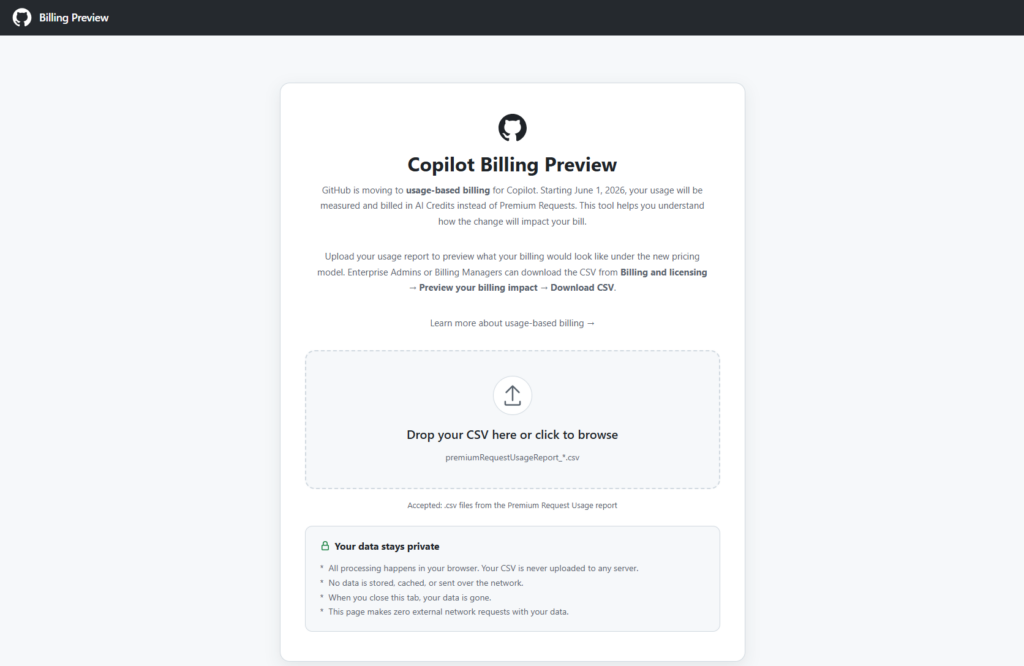
The tool is browser based, and just requires you to drop in a CSV file from the Premium request analytics of your account (which now has some additional fields). It then shows you various visualizations in the browser and extracts useful data from the more verbose report, including specifically some comparisons between your previous cost, and apparent future cost with AI credits instead.
Month comparisons
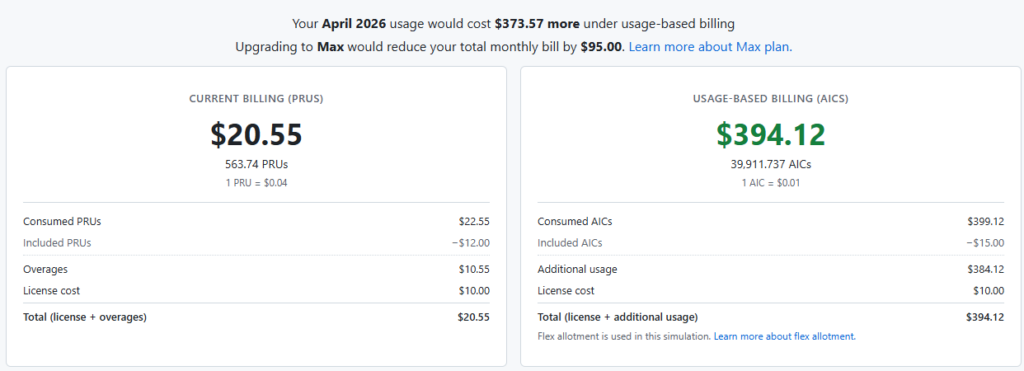
I went back and downloaded all of my new premium request usage report data for this year throughout which I slowly progressed from around 300 PRU per months (premium requests used) toward and past 600 PRU per month (largely due to the cloud agent usage increase. And in summary, this is what the difference between PRU based billing and AICS (AI Credit) billing looks like for me.
| Month | Plan | PRUs | AICs | Current billing (PRUs) | Usage-based billing (AICs) |
| January 2026 | Pro (10 USD) 300 PRU | 293.14 | 1,059.761 AICs | 10 USD | 10 USD |
| Feburary 2026 | Pro (10 USD) 300 PRU | 318.03 | 2,306.479 | 10.72 USD | 18.06 USD |
| March 2026 | Pro (10 USD) 300 PRU | 719.09 | 39,728.397 | 26.76 USD | 392.28 USD |
| April 2026 | Pro (10 USD) 300 PRU | 563.74 | 39,911.737 | 20.55 USD | 394.12 USD |
| 1/2 of May 2026 | Pro (10 USD) 300 PRU | 354.63 | 31,017.761 | 1/2 39 USD | 310.18 USD |
| Projected May 2026 | Pro+ (39 USD), 1500 PRU | 700 | 60,000 | 39 USD | 620 USD |
At this point it’s probably also important to read about how the plans will work form next month, as one of these pages told me that I would save money by using the Max plan. And to be honest, I have been surprised that I have been getting away with such cheap plans given what I would consider a rather heavy and concentrated usage of agentic development in my day to day.
For paid plans, monthly included usage comes in two parts:
- Base credits: matched 1:1 with your subscription price. These never change.
- Flex allotment: variable additional usage on top of your base. Flex allotments will vary over time.
Your base credits are used first. If you go beyond your base, the flex allotment is applied automatically at the same rates across your IDE, github.com, and the CLI. You don’t need to turn anything on or manage a separate bucket; your dashboard will show what’s available and what you’ve used. And if you use everything included in your plan, you can purchase more usage and keep going.
So basically your plan amount now will seemingly line up with a value of AICs for you to use each month, however you get an additional “flex” allowance that makes it the cheaper way to buy this base set of credits. If your preview billing shows that you would only spend $15 per month on AICs, then you are probably best on the Pro plan, if it shows $70 on AICs, you are probably best on the Pro+, and anything above $100 usage, you will be best on the new Max plan. (So it looks like It’ll be Max for me moving forward)
Model comparisons
The preview tool also give you a series of more detailed breakdowns, including by “product” or model. These allow you to tease out which models have the biggest impact in terms of AICs.
And at this point, its also worth taking a look at the changes to the model modifiers that will be happening at the end of the month for those users that will be staying on the to be phased on Pro and Pro+ plans, but that paid for a year up front, as most of the modifiers are going to be changing. For example:
- Claude Sonnet 4.5 goes from x1 to x6
- Claude Sonnet 4.6 goes from x1 to x9
- Gemini 3 Pro goes from x1 to x6
- Even models such as GPT-4o end up increasing from x0 to x0.33
- And let’s not talk about Claude Opus 4.7 which goes from x15 to x27
Back in the land of AICs, its easy to see how some usage of the more expensive models which in the past would have happily fallen within your PRU budget easily send the predicted AIC cost up. In April 2026 I made 120 PRUs to Opus 4.6, which has a PRU Net Cost of only $0.12, but that used 13,015 AICs netting $130.15 AIC cost. (A quick thanks to GitHub for subsidizing my adventure so far).
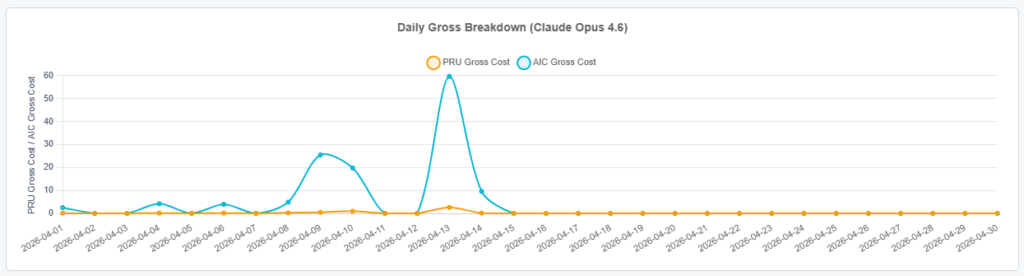
Some models occasionally come out flipped. In the same month, my GPT-5.2 usage PRU cost was $0.88 with an AIC Net Cost of $0.50, so −$0.38. But this was for a very low set of PRUs used at 22, and across the months I looked, this is the only time AICs ended up cheaper.
The GitHub subsidization
I do wonder what this has looked like on the books for GitHub in the past months, and I can only image that is why the billing shifts are happening, and also why the new individual plan subscriptions are locked until the new billing is in place.
I don’t know if these number are accurate, but according to some posts I found in July 2025 Github Copilot had 1.3 million paid subscribers, and by January 2026 GitHub Copilot had 4.7 million paid subscribers. There is no breakdown in terms of plan usage, but the only options for most of this period in terms of paid plans was Pro and Pro+ at 10 USD and 39 USD, so hypothetically let’s say everyone was paying the 39 USD…
4.7 million paying 39 USD per month gives a monthly revenue of $183 million
The Pro+ plan included 1500 PRUs, of which I’m likely only going to make it through 700 this month of rather heavy usage. Again for the sake of napkin maths, let’s say that these paid subscribers actually only make it through 300 PRUs a month (something I have found rather easy in the past). And let’s tie in some of my “real” number above in terms of PRU vs AIC comparison in the more recent months with this latest wave of heavier more expensive models.
May 2026 so far I am at 354.63 PRUs, 31,017.761 AICs, at a cost of $310.18, which for the sake of napkin maths I’ll just adjust down to 300 USD.
And to check April to make sure we are in the correct ballpark, I used 563.74 PRUs, 39,911.737 AICs, at a cost of $394.12, which would be closer to 200 USD if we adjust it to around 300 PRUs
So an average of 250 USD additional cost in the last 2 months?
If we zoom out and apply this to the broader picture, the math gets terrifying for GitHub. We established that 4.7 million users paying $39 a month generates a very respectable $183.3 million in monthly revenue.
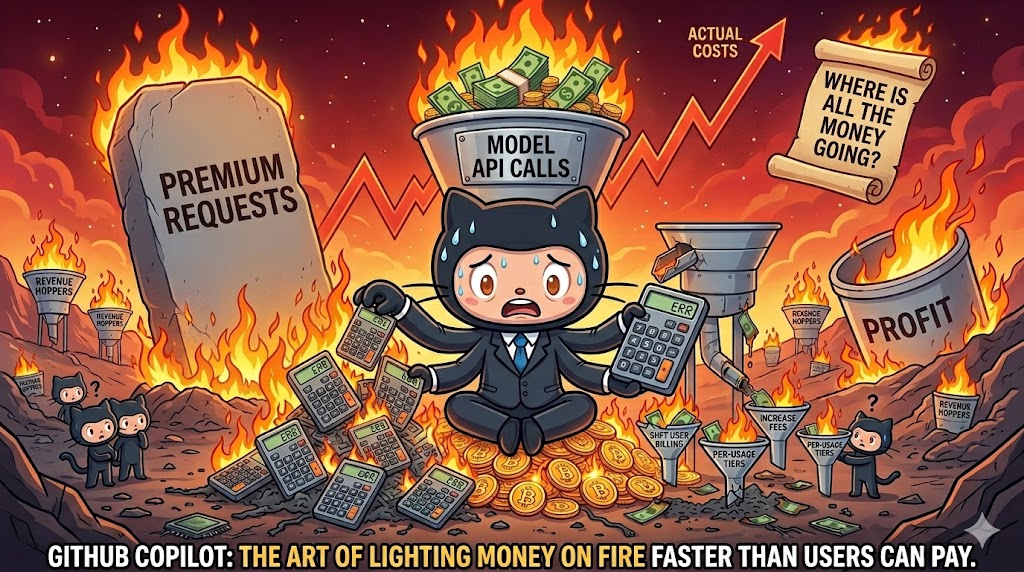
But if we assume that this hypothetical user base is casually burning through just 300 PRUs a month—a fraction of the 1500 PRU limit—at an average cost of 250 USD per user, GitHub is effectively bleeding nearly $1 billion a month ($991.7 million) just to subsidize API calls for heavier, more expensive frontier models. (250 - 39) * 4,700,000
Of course there are other things to consider here in the subscription model, and this is all guesswork really, but even if you assume 100 PRUs per month, there is still a hole, and in reality I imagine many people (including me in some of the past months) actually burst past the plan allocated PRU allowances, and pay for individual PRUs, likely offsetting those users that don’t use all o their plan allocations.
All in all, I can understand why using GitHub Copilot has felt like one of the most cost effective ways to use agentic coding assistance to date.
And to think, only last month I wrote:
I’d love to try out Claude Code more, but the cost benefit analysis doesn’t seem that different to me
Oh how times have changed!