What is Wikibase “Federated Properties” in 2025

I recently wrote a post looking at the history of the Wikibase “Federated Properties” feature. While at Wikimania 2025 the topic of federation came up a few times, particularly given the current discussions ongoing on the Wikidata project chat page including discussions about wikicite, and the recent Wikidata graph split.

All the code for the “Federated Properties” feature still exists in Wikibase code, despite a ticket being open on phabricator to potentially delete it. And it turns out that the configuration for it still exists on wikibase.cloud too, where the feature was initially presented to the communities to try out.

So with a little bit of sneaky “hacking”, I can try to summarize the current / final state of the “Federated Properties” feature, after development during the MVP stopped some years ago.

This also means you can still try out the feature on your own wiki using the setting.

$wgWBRepoSettings['federatedPropertiesEnabled'] = true;

Creating a local property

Firstly, we need a property, and the creation workflow is exactly the same as on a normal Wikibase.

Read more

What was Wikibase “Federated Properties”

The “Federated Properties” feature allows / allowed a local Wikibase instance to access and utilise properties directly from a remote Wikibase, primarily Wikidata. Its primary purpose is to enable partial federation between a local Wikibase and Wikidata, broadening the base of available data without needing to create a property set from scratch.

I’m split between using the present and past tense here, as all of this code still exists within the Wikibase extension, however no one has used it since 2022, and it certainly doesn’t seem to be on the short or medium term (or maybe even long term) roadmaps.

This overview comes from the Wikibase – Federated Properties Phabricator project, which I’ll quote the whole of here for prosperity.

Federated Properties v2 (2021)
An initiative to give users the ability to access remote properties from their local Wikibase and use them in combination with custom local properties. The primary use case is enabling partial federation between a Wikibase and Wikidata. This version of the feature will allow you to:

  • Opt-in to use Wikidata’s properties in addition to your own custom local properties
  • Create and view statements about local entities that contain both local and federated properties
  • Query your Wikibase using both local and federated properties

Federated Properties v1 (2020-2021)
An initiative to give users the ability to access remote properties from their local Wikibase (no local properties were possible in this MVP). This version was launched in the Wikibase Spring Release in May 2021.

As far as I remember, the project died with v2, and I don’t even recall if v2 really saw the light of day outside WMDE internal testing and or hidden testing on wikibase.cloud.

Read more

Visualizing Wikibase ecosystem, using wikibase.world

This entry is part 2 of 3 in the series Wikibase ecosystem

In October last year, I wrote a post starting to visualize the connections between Wikibases in the ecosystem that had been found and collected on wikibase.world thanks to my bot that I occasionally run. That post made use of the query service visualizations, and in this post I’ll take the visualizations a step further, making use of IPython notebooks and plotly.

Previously I reported the total number of Wikibases tracked in wikibase.world being around 784, with around 755 being active (however I didn’t write down exactly how I determined this). So I’m going to take another stab at that with some code backing up the determinations, rather than just my late night data ramblings.

All of the data shown in this post is generated from the IPython notebook available on Github, on 16 Feb 2025, based on the data on wikibase.world which is maintained as a best effort system.

General numbers

MetricValue
Wikibases with properties777
Wikibases with properties, and more than 10 pages600
Wikibases with properties, and more than 10 pages, and 1 or more active users264
Wikibases with properties, and more than 10 pages, and 2 or more active users129
Wikibases that link to other wikibases194
Wikibases that only link to non Wikimedia Foundation wikibases5
Wikibases that link to other wikibases, excluding Wikimedia Foundation35

A few things of note:

  • “with properties” is used, as a clear indicator that Wikibase is not only installed, but also used in at least a very basic way. (ie, it has a created Wikibase property). I would use the number of items ideally as a measure here, however as far as I can tell, this is hard to figure out?)
  • “with more than 10 pages” is my baseline measure of the site having some content, however this applies across all namespaces, so can also be wikitext pages…
  • “active users” are taken from MediaWiki statistics, and apply across all namespaces. These numbers also rely on MediaWiki being correctly maintained and these numbers actually being updated. (Users who have performed an action in the last 30 days)
  • “link to other wikibases” are links extracted from sites by Addbot either via external links or specific properties that state they are links to other wikibases. (The code is not pretty, but gives us an initial view)

And summarized in words:

  • 264 Wikibases with some content that have been edited in the past 30 days
  • 194 Wikibases link in some way to other Wikibases
    • Excluding links to Wikidata and Commons, this number comes down to 35 (So Wikidata is very much the centre)

And of course, take all of this with a pinch of salt, these numbers are an initial stab at trying to have an overview of the ecosystem.

An updated web

My October post included some basic visualizations from the query service of wikibase.world.

However, it’s time to get a little more fancy and interactive. (As well as showing all wikibases, not just the linked ones)

Read more

2 years of wikibase.cloud by WMDE

It’s been somewhere between 2 and 3 years since WMDE took over WBStack, turned it into wikibase.cloud. During this time, my techy focus has slowly shifted away from the world of Wikibase, though I still enjoy following along and working on other Wikimedia areas.

Here I will ramble on about what I saw in terms of potential for wikibase.cloud within the Wikibase ecosystem, as well as what developments have happened within the past years.

The initial problems, goals and dreams

From An introduction to WBStack, I said:

The idea behind the project is to provide Wikibase and surrounding services, such as a blazegraph query service, query service ui, quick statements, and others on a shared platform where installs, upgrades and maintenance are handled centrally.

Now, this is fairly obvious, and clearly something that wikibase.cloud still offers today, however I didn’t write why!? And this is potentially something that has gotten lost through the years of multiple PMs, multiple engineers, multiple project names etc.

Read more

Cloudflare workers for wikibase.cloud uptime & status

Recently I wanted to create a live status page for wikibase.cloud, that also tracking the status of the various services and response times, so that people in the Telegram group might be able to try and correlate their experiences (possibly slow behaviour) with what was seen by others in other locations on other sites, without needing to message in the Telegram group.

In a way, this could be seen as an iteration on the current status page for the service, which is maintained as a static site on Github, making use of cState, a static status page.

Screenshot of the current status page

I initially chose to experiment with Cloudflare Workers to do the minutely checks, after looking around at the current offerings for free online code running (thinking Heroku style etc).

Why Workers?

Read more

2023 Year Review

What a year, I spent most of my time on a sail boat, cruising around the Caribbean etc, and working part-time for Wikimedia on Wikibase.

WBStack became Wikibase.Cloud and the team now working behind it has continued to iterate on the platform, which finally made its way out of its early alpha state. That also came with a snazzy new landing page, and set of logos for Wikibase etc.

Infact, in the last few weeks I finally saw all of the old wbstack Github issues finally migrate onto Phabricator for the team to more easily view and work with.

I look forward to creating an overview of the things that have changed with Wikibase.Cloud year on year at some point, as an overview of the progression of the platform that I still believe is very important to the continued growth of Wikibase.

In the less digital world, I turned our many boaty blog posts and pictures into a book! No you can’t buy one (maybe if we made a 2nd edition. But can we consider ourselves published authors now? It has an ISBN on the back, after all?

Read more

What is Wikibase Cloud (According to Bard)

This is the third in a series of posts where I ask language models, or modern conversational chat bots the question “what is wikibase cloud” to generally see the way they like to answer, and be able to make some sort of comparison of them. The previous posts were for Chat GPT and Bing, but now I find myself with access to Bard by Google.

Firstly, “What is Bard?”

Bard is a large language model, also known as a conversational AI or chatbot trained to be informative and comprehensive. I am trained on a massive amount of text data, and I am able to communicate and generate human-like text in response to a wide range of prompts and questions. For example, I can provide summaries of factual topics or create stories.

Bard, 24 March 2023

On to the main event….

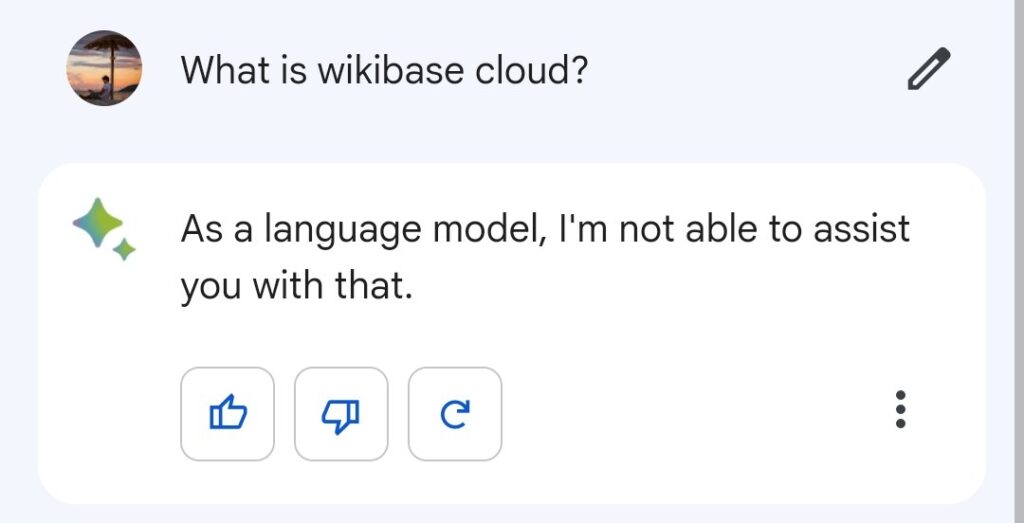
What is wikibase cloud?”

As a language model, I’m not able to assist you with that.

Bard, 24 March 2023

So not off to a very promising start.

Read more

What is Wikibase Cloud (according to Bing AI)

A few days ago I wrote a post called What is Wikibase Cloud (according to ChatGPT). Now I also have access to the new Bing AI chatbot preview, so time to put it to the same test.

This is one of the first times I’m going to have purposefully used Bing since its launch!

As before, Messages to Bing AI will be in bold, things that are wrong, in red, and things that are right in green.

I’ll try to steer the conversation through the same questions that I used with ChatGPT.

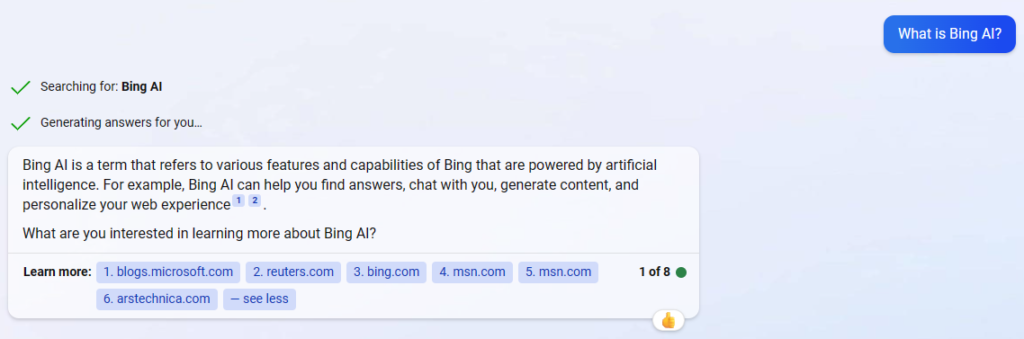
Firstly, “What is Bing AI?”

Bing AI is a term that refers to various features and capabilities of Bing that are powered by artificial intelligence. For example, Bing AI can help you find answers, chat with you, generate content, and personalize your web experience²³.

Source: Conversation with Bing, 06/03/2023
(1) Reinventing search with a new AI-powered Microsoft Bing and Edge, your …. Accessed 06/03/2023.
(2) Factbox: How to get Microsoft’s new AI-enhanced Bing. Accessed 06/03/2023.
(3) Bing. Accessed 06/03/2023.
(4) Microsoft ignores Bing fails by planning to let AI loose on Windows 11 desktops. Accessed 06/03/2023.
(5) Bing AI chatbot now lets you fine-tune its personality. Accessed 06/03/2023.
(6) AI-powered Bing Chat gains three distinct personalities. Accessed 06/03/2023.

I’m really liking the fact that the responses come with references, whereas with ChatGPT you need to ask for the resources that were used to generate the answers. Also, it looks like the “Accessed” date for all of these resources is much more recent, perhaps this means Bing will be better at conversations about more recent ongoings?

This is all also nicely displayed in the UI.

So, “What is Wikibase Cloud?”

Wikibase Cloud is a cloud-based platform that hosts instances of Wikibase, an open-source software suite for creating collaborative knowledge bases¹². It’s currently an invite-only beta service provided by Wikimedia Deutschland¹⁴.

Are you interested in applying for early access to Wikibase Cloud?

Source: Conversation with Bing, 06/03/2023
(1) Wikibase/Wikibase.cloud – MediaWiki. Accessed 06/03/2023.
(2) Wikibase/Wikibase.cloud – Meta – Wikimedia. Accessed 06/03/2023.
(3) wikibase.cloud. Accessed 06/03/2023.
(4) What is Wikibase Cloud (according to ChatGPT) – addshore. Accessed 06/03/2023.

So, now we are apparently reaching the point of self-referential AI, as Bing is referencing the blog post that I wrote a few days ago pointing out where ChatGPT was incorrect about various points regarding Wikibase Cloud.

There is also an interesting prompt by Bing to continue the conversation asking if I want to apply for early access, so let’s give it a go with a simple “Yes”.

Read more

What is Wikibase Cloud (according to ChatGPT)

In this post, I’ll be asking ChatGPT a bunch of questions about Wikibase Cloud. mainly to see how accurate it manages to be, and how helpful the information is.

Messages to Chat GPT will be in bold, things that are wrong, in red, and things that are right in green.

Firstly, “What is Chat GPT?

But I needed to follow up, asking “Can you answer again but in the third person?

ChatGPT is a large language model developed by OpenAI that has been trained on a vast corpus of text data. The acronym GPT stands for “Generative Pretrained Transformer,” which refers to the model’s ability to generate natural language responses to text-based prompts. ChatGPT uses a transformer neural network architecture that enables it to process and comprehend long sequences of text. Its training data is sourced from a diverse range of materials, including books, articles, and websites, and covers a broad spectrum of topics. ChatGPT has been designed to assist users with natural language processing tasks such as answering questions, summarizing text, and generating human-like responses in conversation.

ChatGPT on 4 March 2023

But when asking about Wikibase Cloud it gets a little confused and answers incorrectly…

What is Wikibase Cloud?

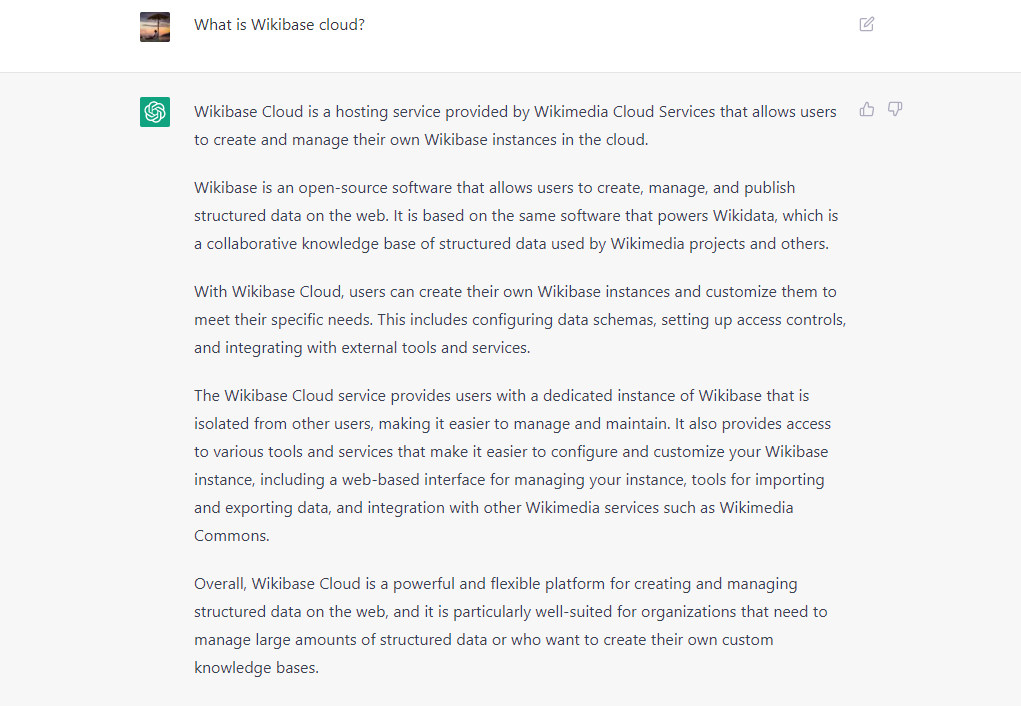
Wikibase Cloud is a hosting service provided by Wikimedia Cloud Services that allows users to create and manage their own Wikibase instances in the cloud. …

ChatGPT on 4 March 2023
The full ChatGPT response for “What is Wikibase cloud”

Wikibase Cloud is a hosting service provided by Wikimedia Deutschland, so the reference to Wikimedia Cloud Services here is incorrect.

So naturally, I need to ask “Are you sure it is provided by Wikimedia Cloud Services?

Read more

2022 Year Review

This entry is part 6 of 6 in the series Year Reviews

I’ve been doing year reviews since 2017 under the #year-review tag, and 2022 is no different. Expect I have been living aboard a sailboat traveling the world for the latter half of the year. So this year is probably going to look a little different in retrospect, including far less time coding and writing about technology, but far more nautical miles traveled.

(the GPS track below is mostly accurate, but also has some odd artifact in it…)

Blogging (and Boating)

The trip has resulted in some alternative blogging about sailboats, and much of which has been on an entirely separate blog https://sailinghannahpenn.co.uk.

In fact, here is a picture of Hannah Penn from last week after hauling out of the water in Guadeloupe for form extra painting.

There is always lots to be doing while sailing, and second to sailing comes enjoyment. I have also been working 10h per week for Wikimedia Deutschland, and altogether this leaves sparse gaps for other things on the side like blogs.

Read more