The last post about AI that I wrote was about GitHub Copilot moving to AI credits, rather than their prior model of something akin to per prompt billing. That was in May, and to be honest, through June, July and August, not much seemed to change for me in the landscape for my productive working hours. (Various things changed and happened in my periphery that I might be able to explore in my personal time).
However September and October really saw another wave of changes that actually lead to impact during my working hours. From the new wave of GPT 6 6.1 models, to the OpenAI dots, and our increasing internal usage of Notion AI for our new internal knowledge base and task tracking, I’m seeing myself rambling on to various LLMs day in day out, and leaving more and more for them to do in the background, vs following along closely with for all of the steps (being an avid GitHub Copilot user before this).
The tides have turned, and I primarily use Codex these days as part of VsCode. With Copilot, the only model that I seem to be able to gel with well and make productive for my usage right now is GPT 5.6 Terra, auto always selects something that seems to take too much time, or perform poorly, meanwhile Codex seems to generally just get shit done, without needing so much human interaction. I imagine I’ll continue using GitHub Copilot for more hand holdy type tasks, and also for “code review” and some basic coding tasks within GitHub Copilot Cloud.
Where the “power” is really coming from in my working day now is having an AI accessible and curatable knowledge base and task tracking system, IDE integration, and consistent chat and context experiences across devices. Along with my first dot, called Bob…
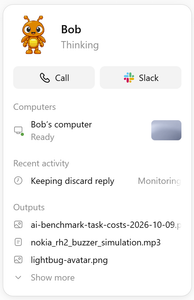
Bob (the Dot)
An OpenAI dot is an always-on, autonomous AI agent inside ChatGPT powered by GPT-6 Astra. I have no doubt that some folks home hosted LLM setups come close to this sort of thing (only with arguably less effective and likely slower models), however for a working setup having this as an off the shelf product is mighty powerful.
For me the Dot is part of the $100 USD subscription that I was already using as part of my day job, and these are rough human effort estimates for comparable work, over a broad set of categories since I created my Dot around 2 working weeks ago.
- Code review and regression tests: 4-10 hours. Reviewed substantial changes, investigated differences in behavior and added tests to help catch regressions before merging.
- Protocol/spec reconciliation: 3-6 hours. Compared documentation with multiple implementations, identified inconsistencies and worked through focused corrections.
- CI, dependency and repository maintenance: 2-5 hours. Investigated failing builds, updated dependencies, fixed linting and reduced unnecessary CI runs.
- SDK and release workflows: 2-4 hours. Improved generated-code publishing, checked that examples compiled and organized verified build artifacts.
- Documentation migration and task updates: 1-3 hours. Moved technical documents and attachments between tools (migrating to Notion), checked the results and kept related tasks and links organized.
- Cross-system investigations: 2-5 hours. Brought together evidence from code, logs, documentation and correspondence to answer questions that crossed several systems.
- Creative experiments: 30 mins-2 hours. Produced small visual and audio experiments, including an animated avatar and simulated device-buzzer playback.
- And for fun on a Sunday to see how much of my usage I could actually use I did some property research and train ticket research, both compiling a large amount of information int Google Sheets. (2-4 hours)
The main thing that stood out around this mode of operation, was again taking it one level of abstraction further up the tree. I no longer (seemingly) have to spend too much time worrying about if I I’m channeling my thoughts into the correct chat / prompt window in the right application to get the thing done that I actually want to achieve.
Some honest feedback about my heavy dot usage. Tools sometimes stalled, some writes needed retries, sources could be stale. The dot delivered research, files and reviewable changes; that doesn’t mean code was automatically deployed, tickets were completed, or every idea became a finished project.
And I can still see how this can come forward in more leaps and bounds and connect slightly more back with IDE based development for situations where having a system run amuck in the cloud just isn’t that productive.
My head hurts (I think)
I really appreciate coming back to this blog after 3 months (I really had no idea it had been that long), and writing some words down that actually stand a chance of being consumed by another human, rather than just being chewed up by a machine, and spat back out after a little bit of processing.
The feeling that everything we are currently working through and with is all just the same set of systems, interactions, communications and processes (all be it with less people involved) as we have experience for many years, decades and arguably centuries. Just it is all happening much faster, and individual people are more capable of directing more parts of the moving systems at the same time.
That being said, the threat of some kind of burnout seems real. I came up with at least 2 new projects I could work on in the past 3 hours, and might be convinced that I have the time these days to just about manage to achieve them to an acceptable standard, but at what cost? (Maybe if I didn’t have a job…)
There are a fair few good blog posts that have been written (I hope primarily by people) on the continued evolution of AI, particularly with a software engineering slant. See below…
After AI takes everything has a few quotes I’ll comment on:
- “Over the past year, every piece of my work that I could hand off, I handed off to AI, piece by piece.” as part of a section called “The Bottleneck Has Moved to Us”.
- I have certainly being doing this, as my workplace is AI positive, and I personally enjoy the learning experience (that keeps changing drastically every quarter), but to me the journey is part of the whole experience.
- “the technical complexity of a single page is bounded; when you break it, the blast radius is your own page, not other systems; even if a page becomes unmaintainable, the cost of rewriting it from scratch is low.” as part of a section called “The Disappearing Moat”
- As someone that has watched this space change from simple auto completions, to the cross task chats we can have today, there was a point a few years ago there this moat became apparent. Systems are often, and likely will always, have some level of complexity to them, however they are ultimately made up of many simple components. The theory from a few years ago of “use AI like an intern” still applies, however its becoming increasingly cheap to rewrite more complex components.
- “The person who picks the right problem gets ten times the output; the person who picks the wrong problem just does the wrong thing ten times as fast.”
- In a nutshell this highlights the likely importance of people in the field of software engineering (in my opinion) to at least get some experience in the field of prompting in their technical space. But I also imagine looking at the wider field this thought path again just highlights the difference between varying levels of engineers, or the way that various different engineers think about the same problems. Of course, getting to any outcome faster is beneficial to all, as even if the outcome is wrong, and something else (such as a human in the loop) can identify that and loop back around to correcting (as has been happening for years already).
AI Didn’t Make Programming Easier. It Just Made It Differently Difficult leads with “The future of software development will belong to those who can think clearly at scale, maintain durable mental models amid rapid change”
- “the hard part moves from recall (“How do I write this?”) to judgment (“Does this actually make sense?”).”
- “these findings support the view that architectural reasoning, impact analysis, and long-term system maintenance cannot be offloaded to AI.”
And some less structured reading…
- “I built the feature almost entirely using my voice, chatting away to my laptop while I cooked dinner.” – Simon Willison’s Weblog – 9 October 2026
- I still don’t scream at my laptop as much as I “would like”, however I did recently spend about an hour researching what van I might want to buy, while driving, and without doing a single web search myself.
- “AI Doesn’t Reduce Work—It Intensifies It” – Simon Willison’s Weblog – 9 February 2026
- Removing the more trivial thinking of remembering how to write the code, how to structure it, how to tie it together, and instead spending more time thinking about the bigger harder more complex questions.
- ““You can just do things” was what was on my mind all the time but it took quite a bit longer to realize that just because you can, you might not want to.” – Armin Ronacher’s Thoughts and Writings – 18 January 2026
- Something I have apparently been ignoring again for the past few months.
- “velocity without understanding is not sustainable” – How Generative and Agentic AI Shift Concern from Technical Debt to Cognitive Debt – 9 February 2026
- To me this is the difference between vibe coding and… vibe engineering? (nah, just engineering right?)
Until next time.
and…
AI didn’t write this