Review & Removal of Wikidata query service Blazegraph JNL on Cloudflare R2

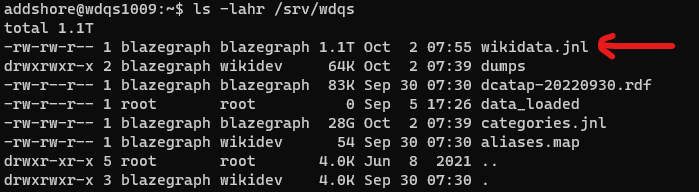
Back in August, I uploaded a new Wikidata query service Blazegraph JNL file to both Cloudflare and the Internet Archive. 4 months on, it is time for me to remove the R2 version of this file, which is costing me around 18 USD per month to store, and fall back to the Internet Archive version … Read more

COVID-19 Wikipedia pageview spikes, 2019-2022

Back in 2019 at the start of the COVID-19 outbreak, Wikipedia saw large spikes in page views on COVID-19 related topics while people here hunting for information.

I briefly looked at some of the spikes in March 2020 using the easy-to-use pageview tool for Wikimedia sites. But the problem with viewing the spikes through this tool is that you can only look at 10 pages at a time on a single site, when in reality you’d want to look at many pages relating to a topic, across multiple sites at once.

I wrote a notebook to do just this, submitted it for privacy review, and I am finally getting around to putting some of those moving parts and visualizations in public view.

Methodology

It certainly isn’t perfect, but the representation of spikes is much more accurate than looking at a single Wikipedia or set of hand selected pages.

  1. Find statements on Wikidata that relate to COVID-19 items
  2. Find Wikipedia site links for these items
  3. Find previous names of these pages if they have been moved
  4. Lookup pageviews for all titles in the pageview_hourly dataset
  5. Compile into a gigantic table and make some graphs using plotly

I’ll come onto the details later, but first for the…

Graphics

All graphics generally show an initial peak in the run-up to the WHO declaring an international public health emergency (12 Feb 2020), and another peak starting prior to the WHO declaring a pandemic.

Be sure to have a look at the interactive views of each diagram to really see the details.

COVID-19 related Wikimedia pageviews (interactive view)

Read more

Wikidata query service Blazegraph JNL file on Cloudflare R2 and Internet Archive

At the end of 2022, I published a Blazegraph JNL file for Wikidata in a Google Cloud bucket for 1 month for folks to download and determine if it was useful.

Thanks to Arno from weblyzard, inflatador from the WMF search platform team, and Mark from the Internet Archive for the recent conversations around this topic.

You can now grab some new JNL files from a few days ago, hosted on either the Internet Archive or Cloudflare R2.

Read more

A first Wikidata query service JNL file for public use

Back in 2019 I wrote a blog post called Your own Wikidata Query Service, with no limits which documented loading a Wikidata TTL dump into your own Blazegraph instance running within Google cloud, a near 2 week process.

I ended that post speculating that part 2 might be using a “pre-generated Blazegraph journal file to deploy a fully loaded Wikidata query service in a matter of minutes”. This post should take us a step close to that eventuality.

Wikidata Production

There are many production Wikidata query service instances all up to date with Wikidata and all of which are powered using open source code that anyone can use, making use of Blazegraph.

Per wikitech documentation there are currently at least 17 Wikidata query service backends:

  • public cluster, eqiad: wdqs1004, wdqs1005, wdqs1006, wdqs1007, wdqs1012, wdqs1013
  • public cluster, codfw: wdqs2001, wdqs2002, wdqs2003, wdqs2004, wdqs2007
  • internal cluster, eqiad: wdqs1003, wdqs1008, wdqs1011
  • internal cluster, codfw: wdqs2005, wdqs2006, wdqs2008

These servers all have hardware specs that look something like Dual Intel(R) Xeon(R) CPU E5-2620 v3 CPUs, 1.6TB raw raided space SSD, 128GB RAM.

When you run a query it may end up in any one of the backends powering the public clusters.

All of these servers also then have an up-to-date JNL file full of Wikidata data that anyone wanting to set up their own blazegraph instance with Wikidata data could use. This is currently 1.1TB.

So let’s try and get that out of the cluster for folks to use, rather than having people rebuild their own JNL files.

Read more

Wikidata query service updater evolution

The Wikidata Query Service (WDQS) sits in front of Wikidata and provides access to query its data via a SPARQL API. The query service itself is built on top of Blazegraph, but in many regards is very similar to any other triple store that provides a SPARQL API.

In the early days of the query service (circa 2015), the service was only run by Wikidata, hence the name. However, as interest and usage of Wikibase continued to grow more people started running a query service of their own, for data in their own Wikibase. But you’ll notice most people still refer to it as WDQS today.

Whereas most core Wikibase functionality is developed by Wikimedia Deutschland, the query service is developed by the search platform team at the Wikimedia Foundation, with a focus on wikidata.org, but also a goal of keeping it useable outside of Wikimedia infrastructure.

The query service itself currently works as a whole application rather than just a database. Under the surface, this can roughly be split into 2 key parts

  • Backend Blazegraph database that stores and indexes data
  • Updater process that takes data from a Wikibase and puts it in the database

This actually means that you can run your own query service, without running a Wikibase at all. For example, you can load the whole of Wikidata into a query service that you operate, and have it stay up to date with current events. Though in practice this is quite some work, and expense on storage and indexing and I expect not many folks do this.

Over time the updater element of the query service updater has iterated through some changes. The updater now packaged with Wikibase as used by most folks outside of the Wikimedia infrastructure is now 2 steps behind the updater used for Wikidata itself.

The updater generations look something like this:

  • HTTP API Recent Changes polling updater (used by most Wikibases)
  • Kafka based Recent Changes polling updater
  • Streaming updater (used on Wikidata)

Let’s take a look at a high-level overview of these updaters, what has changed and why. I’ll also be applying some pretty arbitrary / gut feeling scores to 4 categories for each updater.

Read more

Wikidata maxlag, via the ApiMaxLagInfo hook

Wikidata tinkers with the concept of maxlag that has existed in MediaWiki for some years in order to slow automated editing at times of lag in various systems.

Here you will find a little introduction to MediaWiki maxlag, and the ways that Wikidata hooks into the value, altering it for its needs.

Screenshot of the “Wikidata Edits” grafana dashboard showing increased maxlag and decreased edits

As you can see above, a high maxlag can cause automated editing to reduce or stop on wikidata.org

Read more

Wikidata ontological tree of Trains

While looking working on my recent WikiCrowd project I ended up looking at the ontological tree of both Wikidata entities and Wikimedia Commons categories.

In this post, I’ll look at some of the ontology mappings that happen between projects, some of the SPARQL that can help you use this ontology in tools, and also some tools to help you explore this complex tree.

I’m using trains as I think they are fairly easy for most folks to relate to, and also don’t have a massively complex tree.

Commons & Wikidata mapping

Depicts questions in WikiCrowd are entirely generated from these Wikimedia Commons categories, such as Category:Trains & Category:Steam locomotives. These are then mapped to items on Wikidata such as Q870 (train) & Q171043 (steam locomotive).

Wikimedia Commons categories quite often contain infoboxes on the right-hand side that link to a variety of resources for the thing the category is covering. And quite often there is a Wikidata item ID present, this is the case for the categories above.

Likewise on Wikidata statements for P373 (Commons category) will often exist for entities that are depicted on Commons.

Read more

Testing WDQS Blazegraph data load performance

Toward the end of 2020 I spent some time blackbox testing data load times for WDQS and Blazegraph to try and find out which possible setting tweaks might make things faster.

I didn’t come to any major conclusions as part of this effort but will write up the approach and data nonetheless incase it is useful for others.

I expect the next step toward trying to make this go faster would be via some whitebox testing, consulting with some of the original developers or with people that have taken a deep dive into the code (which I started but didn’t complete).

Read more

Faster munging for the Wikidata Query Service using Hadoop

The Wikidata query service is a public SPARQL endpoint for querying all of the data contained within Wikidata. In a previous blog post I walked through how to set up a complete copy of this query service. One of the steps in this process is the munge step. This performs some pre-processing on the RDF dump that comes directly from Wikidata.

Back in 2019 this step took 20 hours and now takes somewhere between 1-2 days as Wikidata has continued to grow. The original munge step (munge.sh) makes use of only a single CPU. The WMF has been experimenting for some time with performing this step in their Hadoop cluster as part of their modern update mechanism (streaming updater). An additional patch has now also made this useful for the current default load process (using loadData.sh).

This post walks through using the new Hadoop based munge step with the latest Wikidata TTL dump on Google clouds Dataproc service. This cuts the munge time down from 1-2 days to just 2 hours using an 8 worker cluster. Even faster times can be expected with more workers, all the way down to ~20 minutes.

Read more

Using OpenRefine with Wikidata for the first time

I have long known about OpenRefine (previously Google Refine) which is a tool for working with data, manipulating and cleaning it. As of version 3.0 (May 2018), OpenRefine included a Wikidata extension, allowing for extra reconciliation and also editing of Wikidata directly (as far as I understand it). You can find some documentation on this topic on Wikidata itself.

This post serves as a summary of my initial experiences with OpenRefine, including some very basic reconciliation from a Wikidata Query Service SPARQL query, and making edits on Wikidata.

In order to follow along you should already know a little about what Wikidata is.

Starting OpenRefine

I tried out OpenRefine in two different setups both of which were easy to set up following the installation docs. The setups were on my actual machine and in a VM. For the VM I also had to use the -i option to make the service listen on a different IP. refine -i 172.23.111.140

Read more